I flew into Punta Cana expecting two days of connectivity policy. Useful context, adjacent to what I actually build. That was wrong. The Caribbean Digital Transformation Accelerator, hosted by the U.S. Department of State's Bureau of Cyberspace and Digital Policy, turned out to be a compressed education in the machinery that decides whether an AI company in Georgetown can ever operate at regional scale. Cables, spectrum, procurement law, concessional finance, and the political economy binding them together.
What is in this piece
Delegations from close to seventeen markets were in the room, alongside Cisco, Liberty Latin America, Ericsson, SpaceX, Amazon Leo, AST SpaceMobile, Viasat, Xtera, NAP del Caribe, AP Telecom, the U.S. Development Finance Corporation, the FCC, the Commercial Law Development Program and Taiwan's ICDF. The format was deliberately conversational, panels rather than presentations, with the floor opened almost every time.
What follows is a session-by-session record of both days, assembled from my own recordings and photographs and cross-checked against the published programme. After each session I set down what it means for the work we do at V75 Inc. and TrueSelph.
The foundations underneath all of it
Somewhere in the middle of Day 1 I started sketching. Every session was describing a different floor of the same building, and nobody drew the building. This is the version I ended up with, checked afterwards against the two days and against the frameworks that already exist: the World Bank's five pillars for digital economies, the digital public infrastructure model, and the compute-to-applications AI stack. Two layers turned out to be missing from my first sketch, and they are marked.
The foundations of a Caribbean digital economy
Nine layers in three tiers, read from the ground up. Each layer is only as useful as the one beneath it, and three forces cut across all nine.
The three cross-cutting forces. Capital because every layer needs financing and each has a different instrument, from USTDA feasibility grants at the bottom to acceleration funds at the top. Regional coordination because no single Caribbean market is large enough to close a business case alone, which is as true of spectrum and cable as it is of a shared AI data centre. Sovereignty because it is the question that recurs at every level: whose network, whose law, whose data, whose models.
The two gaps in my first sketch. I had started at telecoms, but energy sits under it, and in this region it cannot be assumed the way the standard frameworks assume it. And I had gone straight from policy to applications, missing digital public infrastructure entirely, which is the layer that converts a connected population into a transacting one. I also moved skills from a cross-cutting concern, where the World Bank places it, into a layer of its own, because in this region it is specifically what gates the value tier.
Day One: Friday, 7 August
Trust as an engineering property. What "trusted infrastructure" means once you have to write it into a decree, a tender document and a cable route.
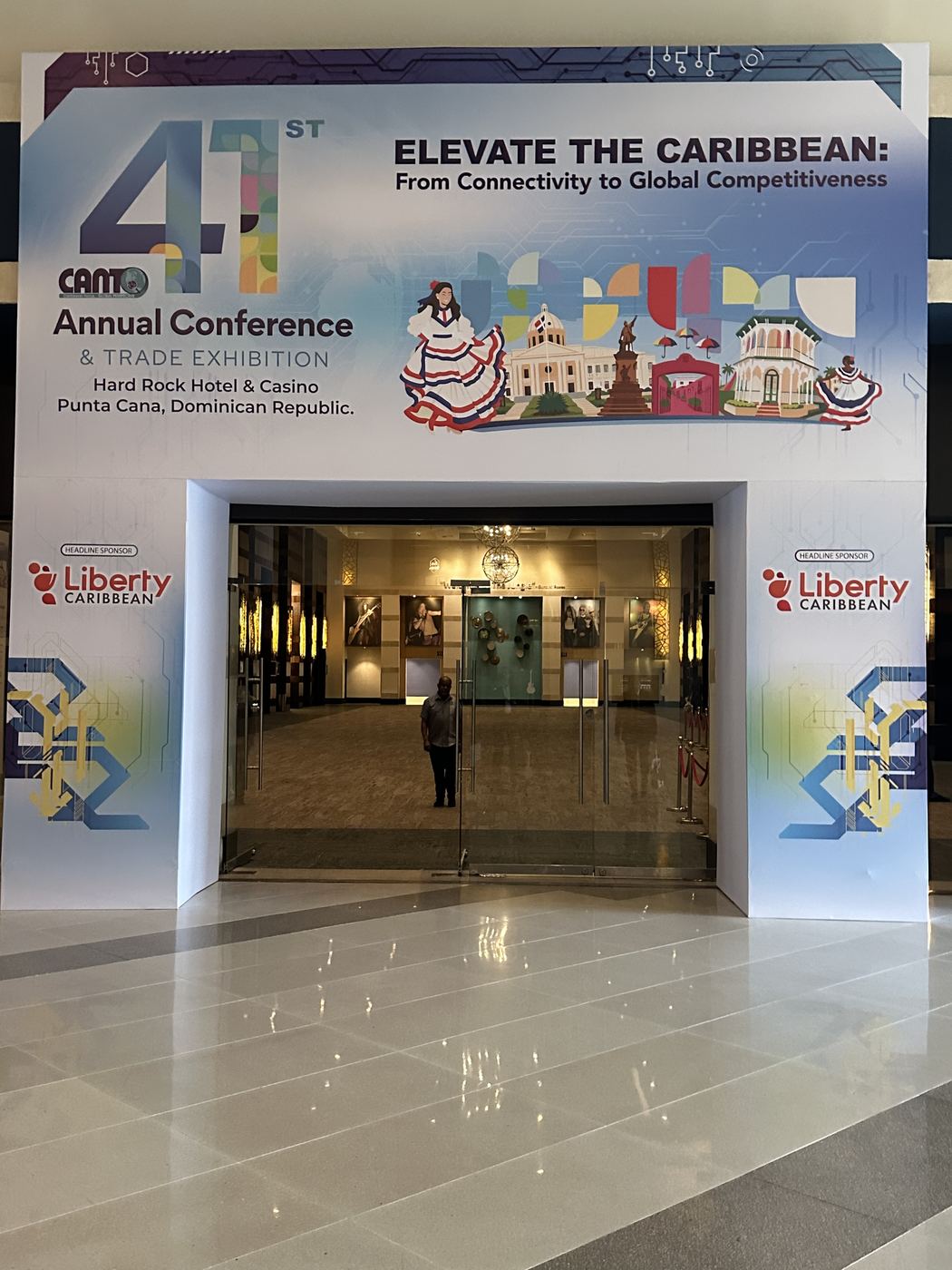 08:11 · The convention centre at the Hard Rock Punta Cana, co-located with CANTO's 41st Annual Conference. The banner theme, "Elevate the Caribbean: From Connectivity to Global Competitiveness," turned out to be the argument the next two days would test.
The gigabit society, and the bill attached to it
Mallika Iyer and Kim Tuminaro, Bureau of Cyberspace and Digital Policy, U.S. Department of State
Lisa Agard, Chair, CANTO C9 Working Group
The opening set the economic frame with numbers rather than pleasantries. Connectivity is not an endpoint but a platform: the substrate beneath digital government, education, healthcare, financial services, tourism, cloud, artificial intelligence, emergency communications and regional integration. For small island and coastal states, digital infrastructure is also resilience infrastructure.
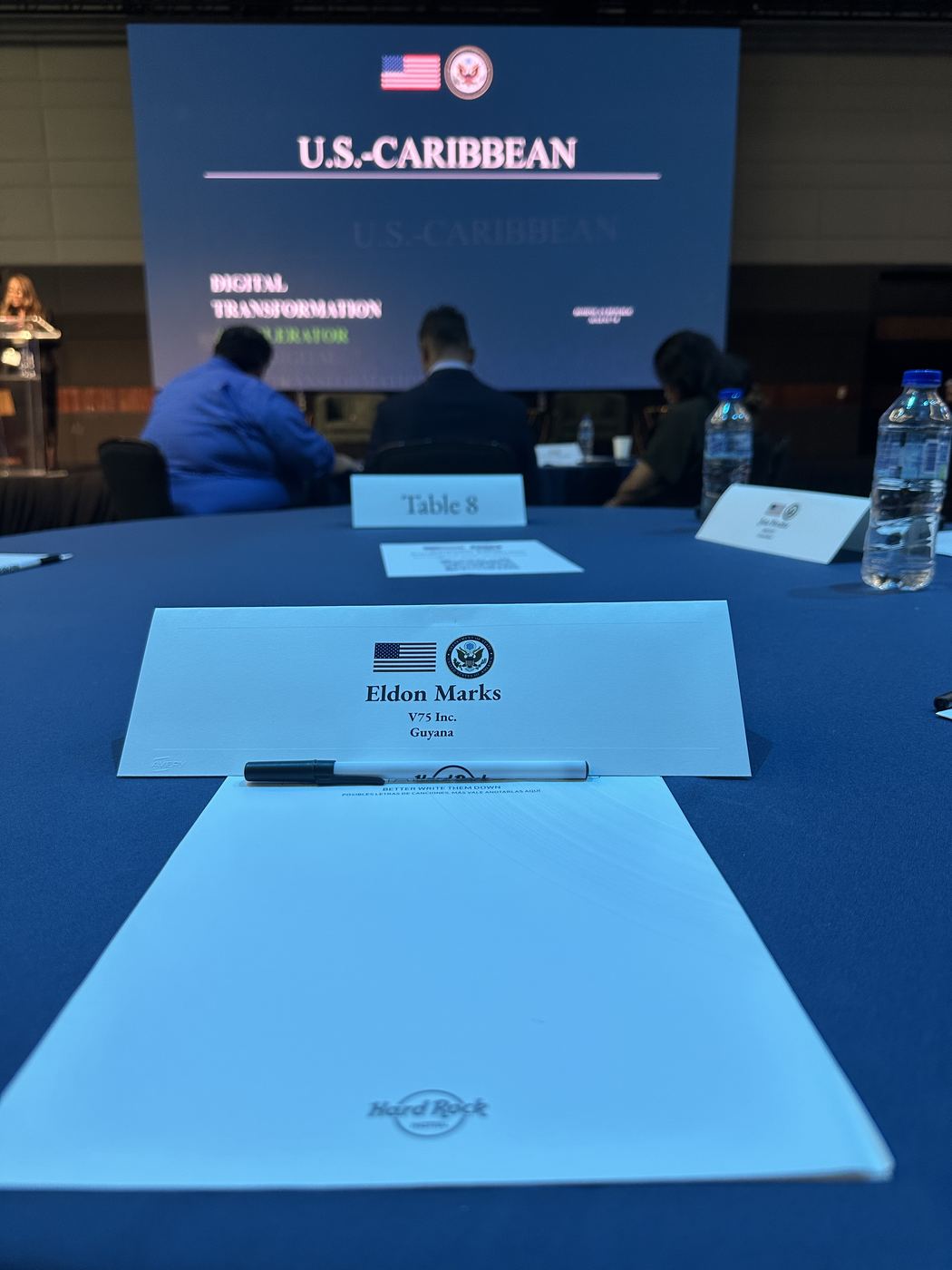 09:15 · Table 8. Delegations were seated in mixed groups rather than by country, a small design choice that shaped the whole two days.
Then the arithmetic. Caribbean operators have been investing on the order of half a billion US dollars a year while holding consumer prices down, and millions in the region remain unconnected. Two structural facts sit underneath: markets are small and geographically fragmented, so per-subscriber build costs are punishing; and several of the submarine systems the region depends on are approaching the end of their design life.
On the record
- Operators have invested conservatively more than $500 million annually in recent years while preserving affordability, and the gap still widened.
- Subsea cable, terrestrial fibre, mobile, cloud and data centres, and LEO satellite were framed as complementary layers of resilience, explicitly not competing alternatives.
- Roles were assigned across the chain: governments supply coherent policy, regulators predictability, operators modernisation, technology companies innovation and local partnership, financiers capital.
- Infrastructure alone does not deliver development. Skills and regional coordination were named as the difference between capacity and value.
What this means for me
- Quintupling capacity while revenue barely moves reframes the customer. Every capital-efficient, software-led alternative to heavy build becomes commercially interesting, and that is the market V75 sells into.
- AI was named in the opening breath of a State Department infrastructure event as one of the workloads this investment exists to carry. In Georgetown I no longer argue the case from first principles. My job shifts from persuasion to execution.
- The skills caveat is the opening for local firms. Capacity is bought. Value is built on top of it, locally, by people who understand the sector.
“This is a survival exercise”
Minister of Industry, Commerce and MSMEs, Dominican Republic, Eduardo "Yayo" Sanz Lovatón, previously Director General of Customs
The sharpest speech of the two days, and the least diplomatic. The case was geoeconomic: supply chains have realigned away from lowest-cost sourcing toward proximity and shared values, and the Dominican Republic intends to win manufacturing on those grounds. The hinge was that it will only be allowed to do so if it can demonstrate a secure digital and legal system. Without that, no semiconductors, no high-end electronics, no place in the new manufacturing matrix.
His best analogy came from running Customs. By buying the same scanners and x-ray equipment used in Florida and Europe, so trading partners would recognise Dominican standards, container dwell time fell from around nine days to two. Standardisation, he argued, is the currency of the digital world in exactly the same way.
He was equally candid about political economy. Invest public money for a five-year payoff and the attacks start within fifteen minutes; legitimacy has to be built through years of communication. I asked him to expand on his AI enablement work, and argued that the region should be pooling findings and pitfalls rather than each country rediscovering them alone. His answer was the most directly copyable thing I heard.
The two AI programmes he described
- An OAS private-sector chapter pilot in which the Dominican Republic was selected to give roughly 50 small enterprises technical advisory support on applying AI, designed to be replicated across Latin America.
- A ministry programme deploying "tech ambassadors", university students in IT, engineering and coding, to sit alongside micro-entrepreneurs and teach practical AI tools, run through Dominican universities.
- Deliberate targeting. Banks and large enterprises already use AI and need no help. Government should focus on the owner of a five or ten-person business: payroll, tax calculation, everyday operations.
- On energy for data centres, the DR has surplus generation and exports power regionally. The binding constraints are distribution lines and the cost of solar storage. Discussions with Google contemplated a facility with its own dedicated generation.
If you're a bank and you're not using AI, you're going to be out of business soon. Where government needs to act is the business with five employees.Minister of Industry, Commerce and MSMEs, Dominican Republic
What this means for me
- His segmentation is exactly the gap I keep hitting. Enterprises and banks self-serve, so both the public-value case and the underserved commercial market sit with the five to ten-person business. That is Guyana's MSME base almost precisely, and it is an agent-shaped problem, not a consulting-shaped one.
- The tech-ambassador model is the part I want to steal. Pairing university students with micro-enterprises distributes adoption support at a cost a small state can carry, and gives young technical people commercial exposure they cannot otherwise get. We have the university relationships in Guyana, and TrueSelph is the natural tooling layer underneath.
- Friendshoring changes the pitch. If market access to the U.S. and Europe gets conditioned on demonstrating secure data handling, then "we build AI systems that are auditable and keep your data where you can see it" stops being a feature and becomes a trade argument.
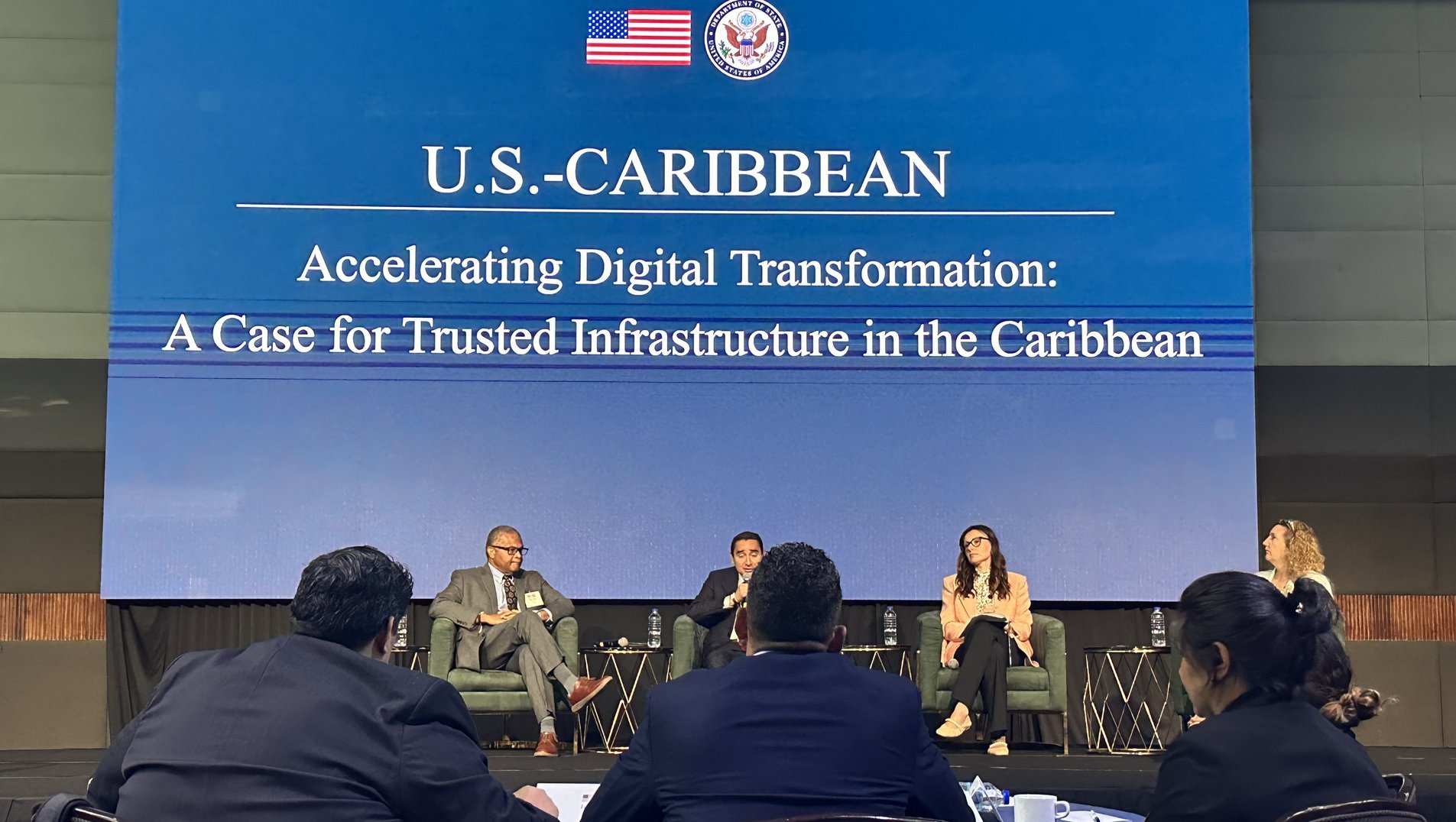
Accelerating Digital Transformation: A Case for Trusted Infrastructure
Kim Tuminaro, U.S. Department of State (moderator)
Tajma Rahimic, Senior Attorney Advisor, Commercial Law Development Program, U.S. Department of Commerce
Edward Carlson, Senior Legal Advisor, Federal Communications Commission
Tony Mosely, Advisor, AP Telecom
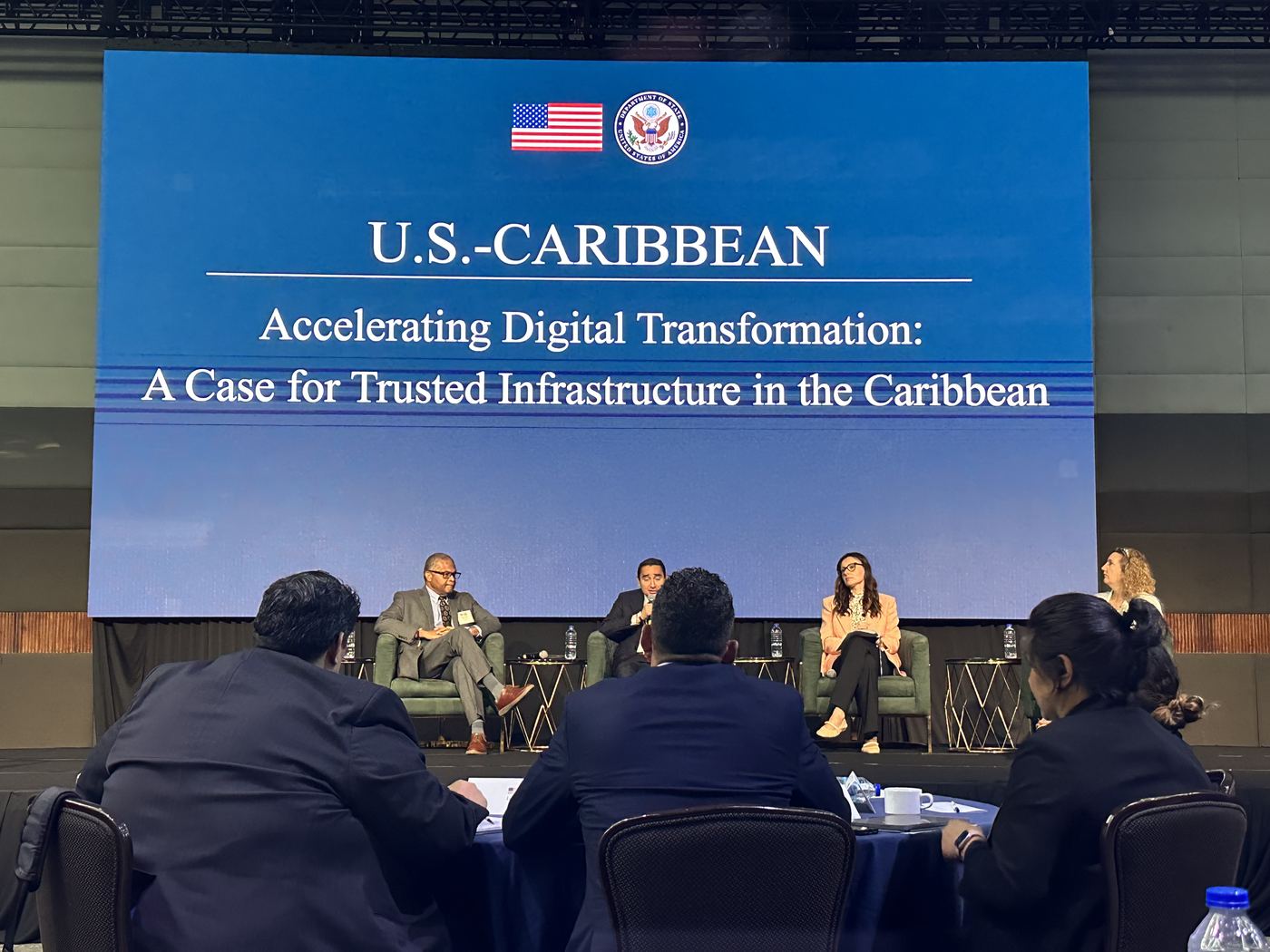 10:23 · Working through what the phrase means once you have to write it into law.
"Trusted infrastructure" survives on a slide and collapses on contact with a procurement document. This panel took it apart. CLDP framed three layers: physical infrastructure from trustworthy suppliers; cybersecurity and resilience; and the legal and regulatory layer, meaning enabling legislation, genuine industry consultation, removal of regulatory barriers to investment, cross-border data governance that permits data to flow, and transparent procurement.
The FCC brought an open offer and a warning. It provides direct technical assistance on spectrum and satellite licensing, regulatory frameworks and security. The warning: do not call after the incident. Twenty, thirty, forty minutes of downtime translates into millions of dollars, and because the United States interconnects with every Caribbean partner by cable and satellite, the security of each network is a shared interest.
Five tests for trusted digital infrastructure
- Reliability. Mission-critical operations run on this. What does an unreliable system cost the businesses depending on it?
- Physical security and redundancy. Cable mishaps happen constantly and often through nobody's fault. A planned alternative is part of the definition, not an extra.
- Transparency. Can you audit it? Do you understand how it works? No hidden black boxes, no hidden dependencies.
- Data protection. Does individual and corporate data stay protected as it crosses the network?
- Sovereignty. The decisive test. Are you in control of your network, or is someone else?
It is not just about the United States. It is about whether the partner you are working with respects all of these dimensions.Kim Tuminaro, U.S. Department of State
Subsea cables carry roughly 99% of all intercontinental digital traffic. AP Telecom put the value of transactions crossing them at $15 to 20 trillion a day, at the high end of published estimates. On procurement his discipline was blunt: the cheapest and fastest bid is not automatically the one that meets the requirement, and total cost has to include what a vendor's choices cost you later.
What this means for me
- Those five tests are now my evaluation framework for every infrastructure and cloud partner we build on. I can run a hosting decision through the list in ten minutes, and hand it to a client deciding where their data should live.
- Cross-border data governance is the commercially loaded one. Whether a Guyanese AI company can serve regional clients, or run workloads in an offshore cloud region, depends on whether the legal regime permits data to move. That is the difference between a national business and a regional one.
- The free advisory channel is worth using. CLDP will read draft law before it passes; the FCC will help with licensing and security frameworks. Expert commentary on a draft is enormously cheaper than amending it afterwards.
Trusted Vendor Policy in Practice in Costa Rica
Geoff Carr, U.S. Department of State (moderator)
Jose Peralta Carranza, Spectrum Manager, Ministry of Science, Innovation, Technology and Telecommunications (MICITT), Costa Rica
Sadinoel Martínez, Country Manager, Dominican Republic, Ericsson
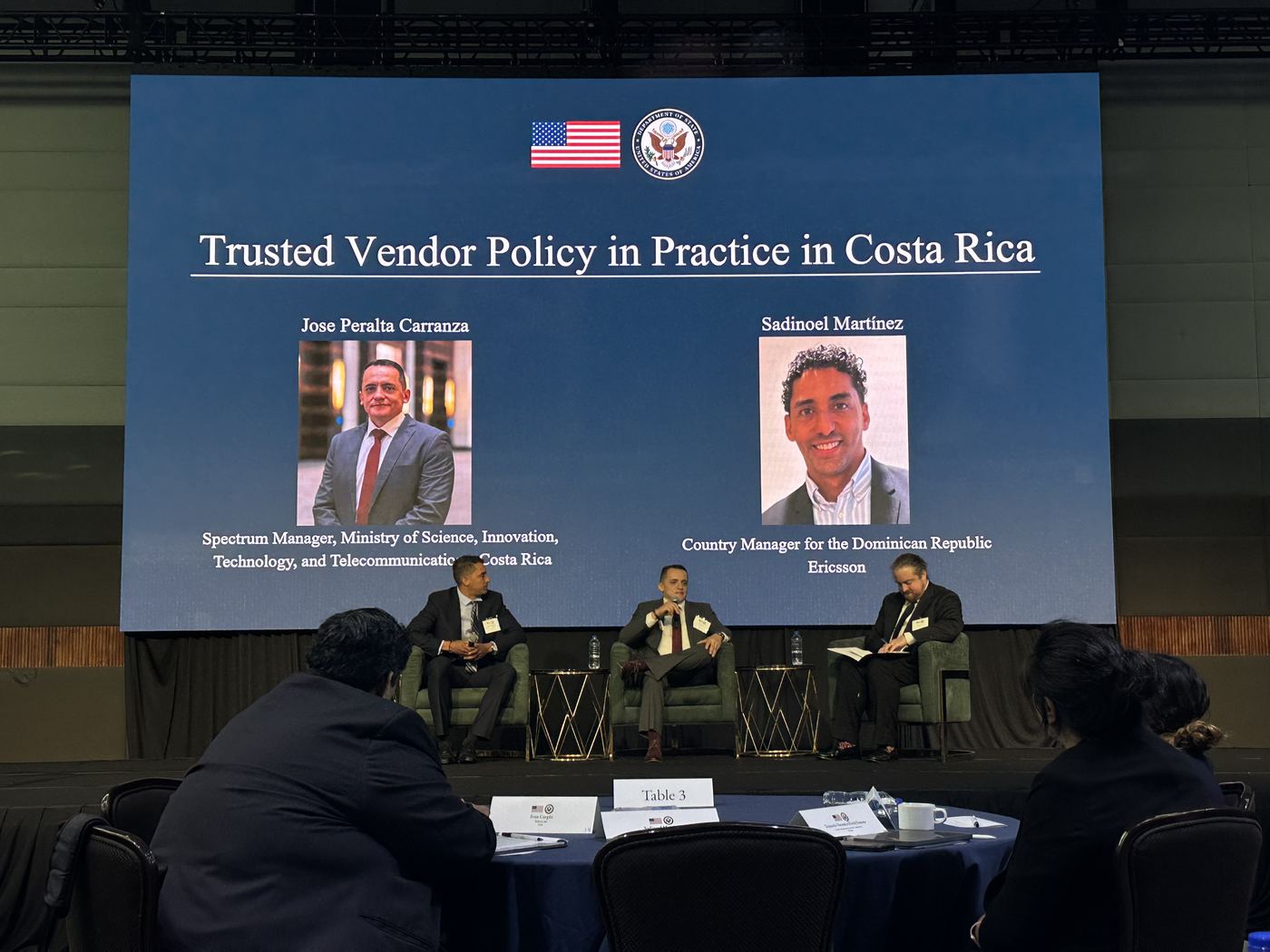 10:49 · MICITT and Ericsson open the Costa Rica case study.
The best session of the conference, because it was the only one where somebody walked through a real crisis, a real legal instrument, and the real fight that followed.
In 2022 a cyberattack crippled Costa Rican critical infrastructure, the social security system and finance ministry among them, with services down for days. Roughly 28,000 medical appointments were lost along with numerous surgeries. The trail led to actors in jurisdictions that do not pursue cybercrime.
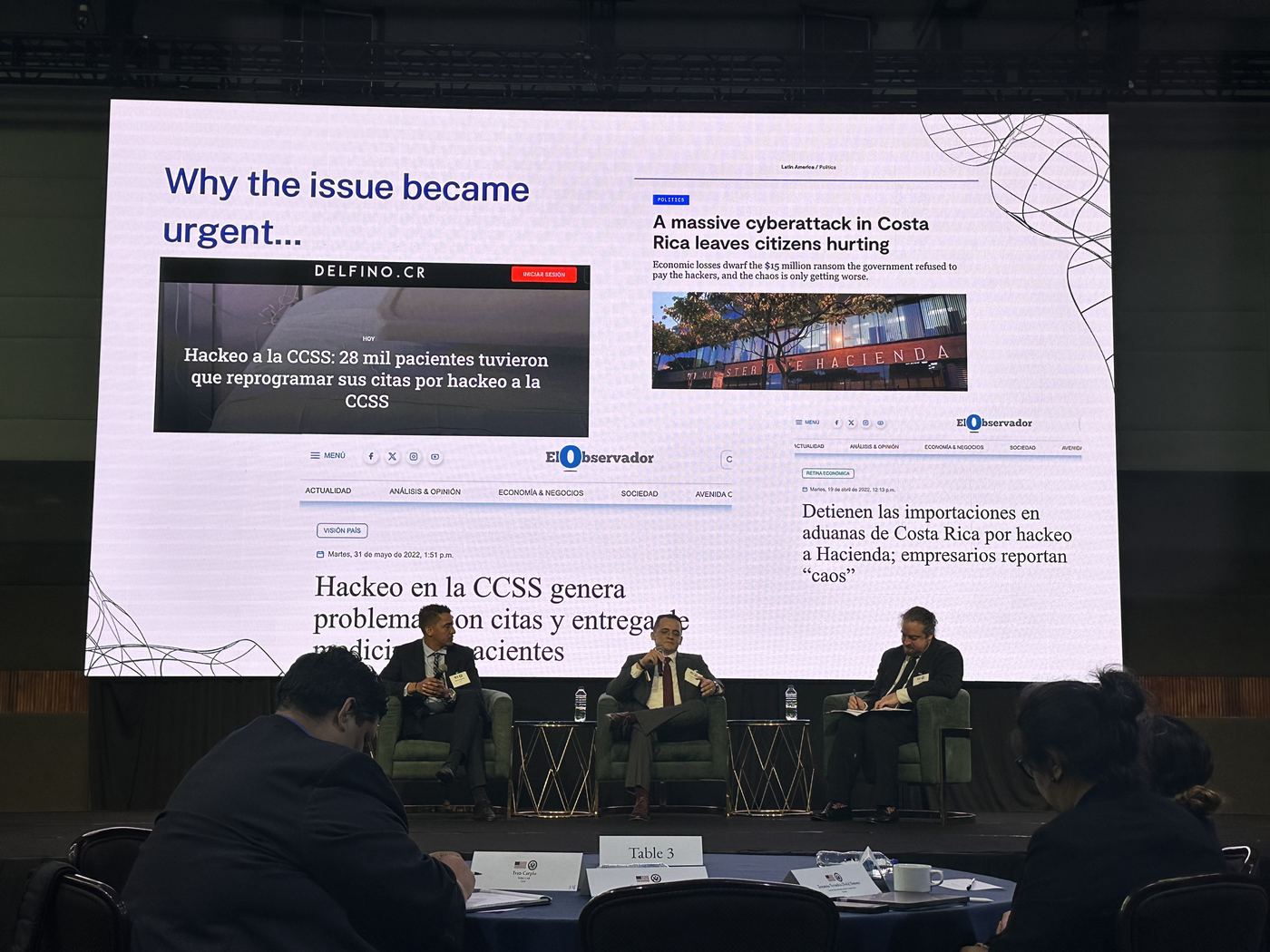 10:52 · "Why the issue became urgent." Headlines from 2022: 28,000 patients rescheduled after the CCSS hack; customs imports halted after the finance ministry breach.
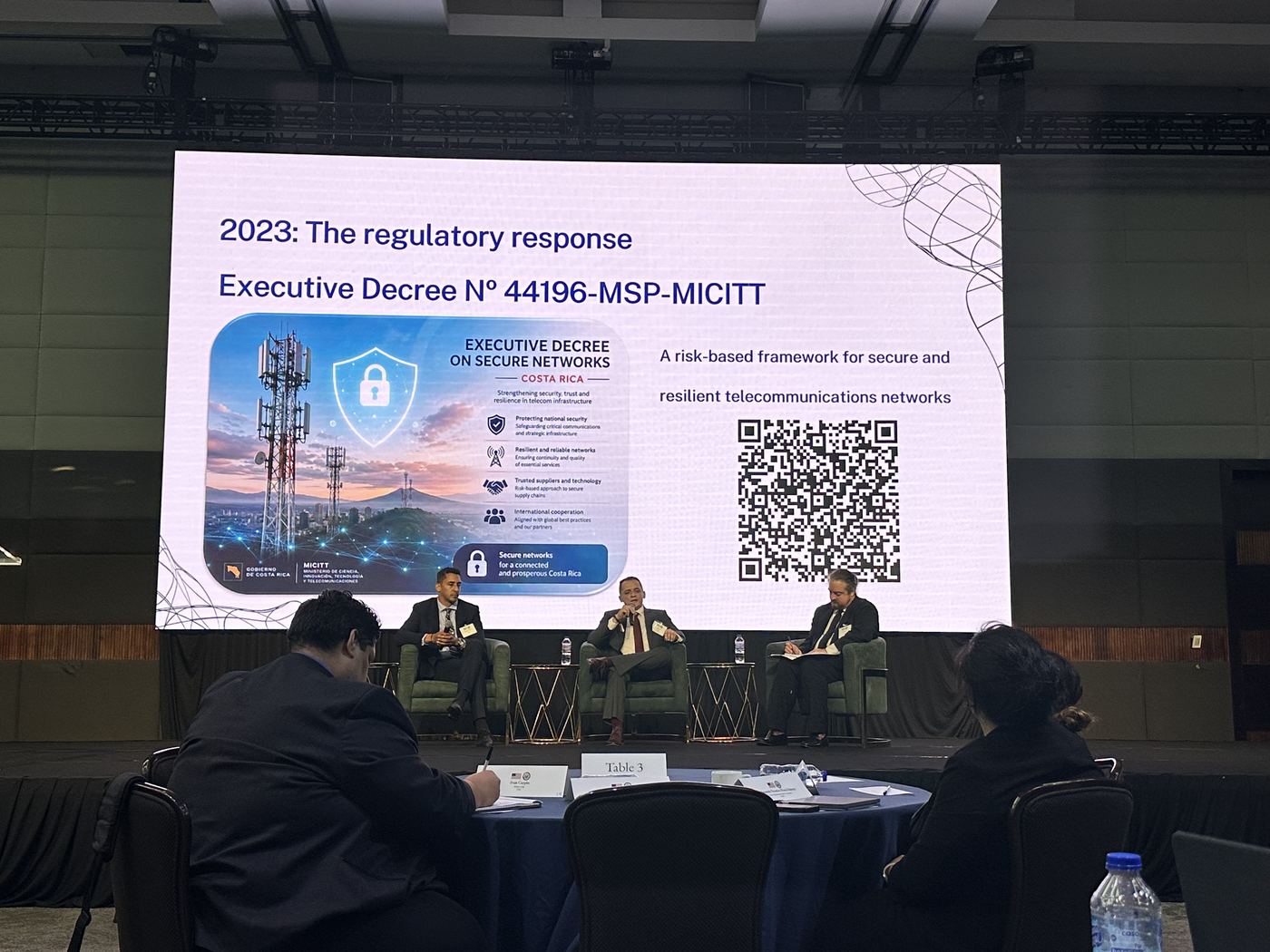 10:54 · The regulatory response: Executive Decree Nº 44196-MSP-MICITT, a risk-based framework for secure and resilient telecommunications networks.
The answer was an executive decree: a deployment guideline for operators building mobile, 4G, 5G and eventually 6G networks inside a secure and resilient framework. Peralta Carranza was emphatic on a point that gets lost in coverage. It bans no brand and no country. It requires operators to run a supply-chain risk assessment and work with trusted partners, so that a competitive market operates more securely.
Its durability came from where it was anchored. Because it rested on technical standards and the Budapest Convention rather than on politics, it has survived repeated legal challenge, litigation still running in 2026, backed, the panel said, by China through its vendors, alongside letters from foreign governments opposing the measure.
Ericsson then drew a distinction I had not previously had language for. Security is the measurable, auditable part: secure standards such as 3GPP, security by design, ethical hacking and penetration testing, deployment security, security in operations. Trust is a human judgement about a company. Is it autonomous and politically independent enough to decide on commercial grounds, and is its governance transparent?
There cannot be security without trust, and trust cannot exist without security.Sadinoel Martínez, Ericsson
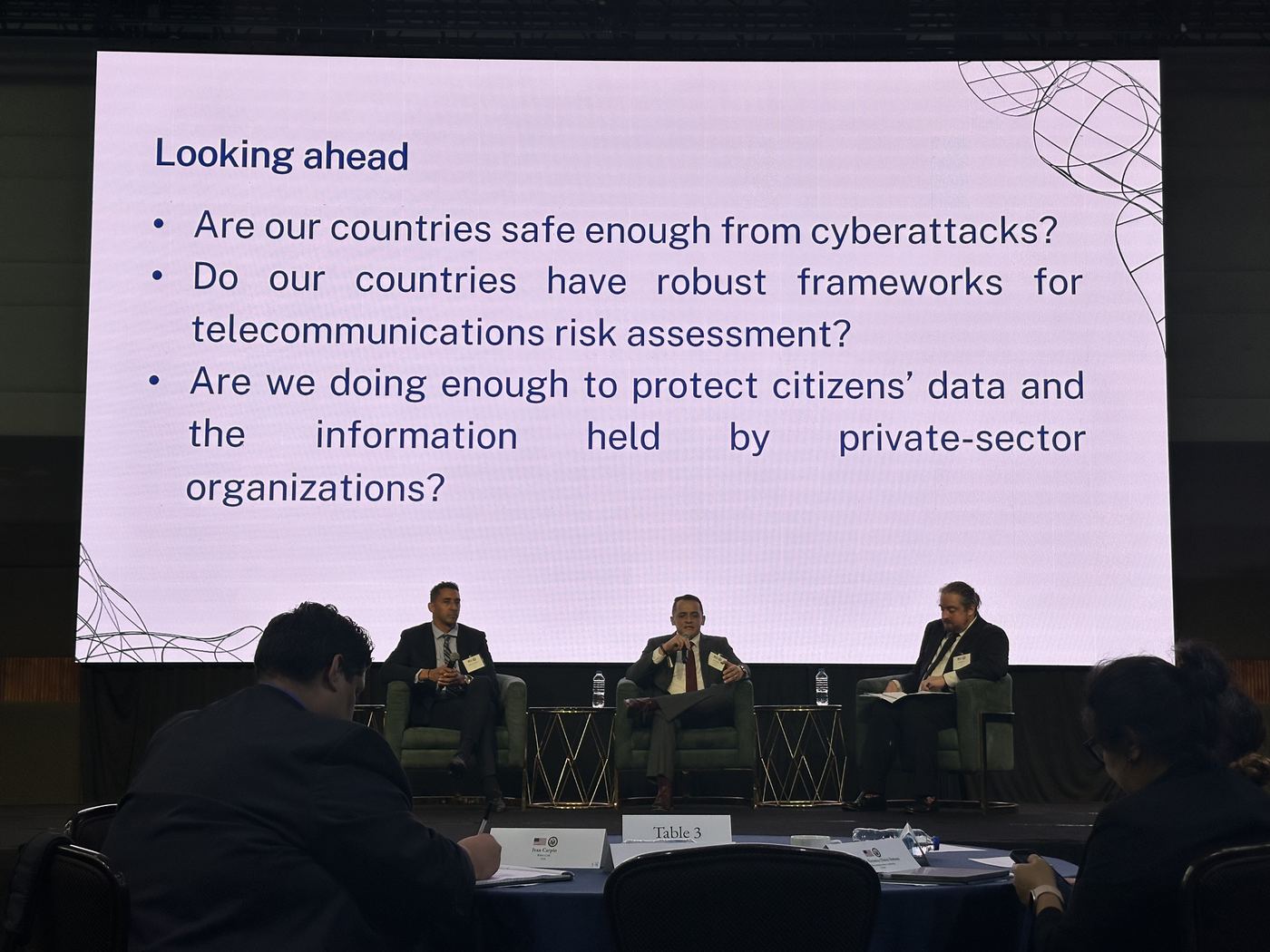 10:56 · The three questions Costa Rica left the room with.
On the record
- On cost, the main objection, the panel countered that in a recent European award the trusted vendor's public price came in significantly below the operator's budget for the incumbent, and that there is no example of an operator raising consumer prices after switching to trusted technology. Price collapses appear where a state-backed vendor is buying market share.
- Claimed benefits: rising citizen confidence in telecoms and digital public services despite continuing attacks, with enterprises in transport and mining now writing trusted-connectivity requirements into their own RFPs.
- 5G enables digital transformation of automotive, energy grids, ports, airports, health and education, which raises the value at stake and therefore attacker interest. 6G adds sensing, generating far more intimate data such as health status, home layout and occupancy.
- Transparency during the incident was the decisive crisis-management lever. Costa Rica did not hide the facts, which preserved public trust and kept investors from fleeing.
- The policy is paired with a national digital-literacy programme, so citizens are "a little less exposed", not just regulators.
The small-market question, asked and answered
- An operator from a very small market asked what every Caribbean delegation was thinking: minimum vendor configurations are sized for populations larger than the entire country being served.
- Ericsson's answer was concrete. A compact packaged integrated core bundling the network functions a small market actually needs, and a core-as-a-service offering delivered in partnership with Google Cloud, billed monthly per subscriber. Network core capability as operating expense rather than capital build.
What this means for me
- Where you anchor a policy is the whole game. Ground trusted-vendor rules in technical standards and an international treaty and they survive the diplomatic and legal pressure that will absolutely follow. Ground them in geopolitics and they do not. Given the Huawei and ZTE footprint at home, someone in Guyana should be making this argument, and should start from the standards.
- Core-as-a-service validates the pattern I keep returning to. Small markets can buy capability as monthly opex instead of capital build, delivered from cloud. That is exactly the model TrueSelph sells. The affordability objection I get in every Guyanese procurement conversation now has a standard answer, and it is not only mine.
- 6G sensing is a marker for where AI data governance is heading. If networks start inferring health status and household occupancy, every company handling regional personal data will be operating under obligations that do not exist yet.
Writing Regulations for Secure ICT Tenders
Tajma Rahimic, Commercial Law Development Program, U.S. Department of Commerce
Edward Carlson, Federal Communications Commission
With a senior Dominican Republic regulatory official on the panel
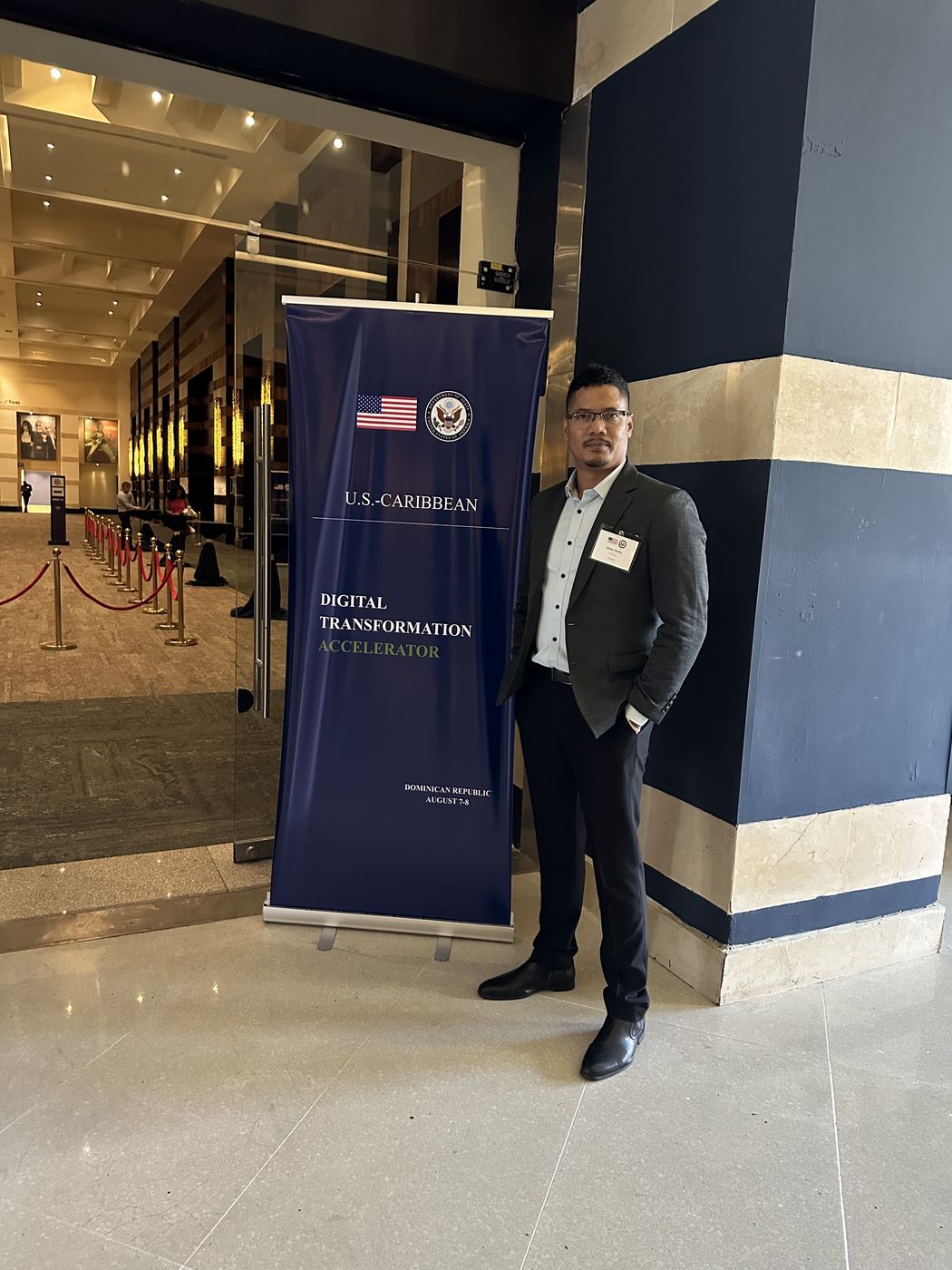 13:01 · Between sessions on Day 1.
The most practical half hour of Day 1: how a small state writes security into a tender without inventing bespoke language it cannot defend.
Three anchors, instead of writing your own
- SCS 9001. The Telecommunications Industry Association's supply-chain security standard, effectively ISO-derived with around eight additional sets of security criteria, including whether a supplier's board and corporate structure are genuinely independent enough to decide on commercial rather than state grounds.
- An international treaty such as the Budapest cybercrime convention, which supplies a ready-made baseline.
- Other governments' covered or prohibited-equipment lists, produced by their intelligence services, while keeping the right to make your own determination.
He then reframed the whole exercise as risk appetite, which is the framing I found most useful. Price it. What does thirty minutes offline cost your GDP? Two hours? A week? What does dependence on a single vendor supplying eighty or ninety per cent of your network mean for sovereignty, coercion and trade leverage? And note the timing: the 4G to 5G refresh is the cheap moment to change vendors, because lifecycle replacement costs a fraction of rip-and-replace.
How much risk are we willing to accept? If you can't answer that honestly, you're doing a disservice to the people you serve.Edward Carlson, Federal Communications Commission
Also on the record
- The EU 5G Toolbox was cited as evidence that technical measures alone are insufficient; strategic, non-technical supplier factors must be assessed too.
- "Technology moves way faster than legislation", hence anchoring to standards rather than writing specifications into statute.
- The Dominican Republic is reforming a telecommunications law dating from 1998, and has recommended a tiered risk classification of low, sensitive and critical for digital infrastructure and services.
- A telling Dominican example: a contractor outage caused by a rat chewing through fibre, discovered only after the fact, with no obligation on anyone to disclose the cause.
- The Dominican official's warning: trusted-vendor criteria must be objective, transparent and verifiable, but should also weigh geopolitics and deliberately create space for local vendors, rather than locking a national network to one foreign player for decades.
What this means for me
- The tiered risk classification is the most portable idea here. Low, sensitive, critical. In Guyana that maps immediately onto e-ID, health records, revenue systems and oil-and-gas monitoring, and gives a defensible basis for demanding different assurance at different tiers instead of arguing every procurement from scratch.
- The line I wrote down twice was the Dominican official's: trusted-vendor policy must not become de facto lock-in to a single foreign supplier, and governments should deliberately create conditions for local vendors. That is a hook a Guyanese firm can cite when bidding for government work, and it came from a regulator rather than an interested party. It reframes "buy local" from protectionism into risk management.
- The incident-disclosure gap is a market. Nobody was obliged to report why the network went down. Monitoring, attestation and assurance is a service, and it has to be local.
Undersea Cables as the Backbone of the Digital Economy
Meghan Lefeber, U.S. Department of State (moderator)
Maria Waleska Alvarez, CEO, NAP del Caribe
Tony Mosely, AP Telecom · Robert Richardson, Chief Sales Officer, Xtera
Dennis Waters, Liberty Networks · Stephen Gilharry, Belize Electricity Limited
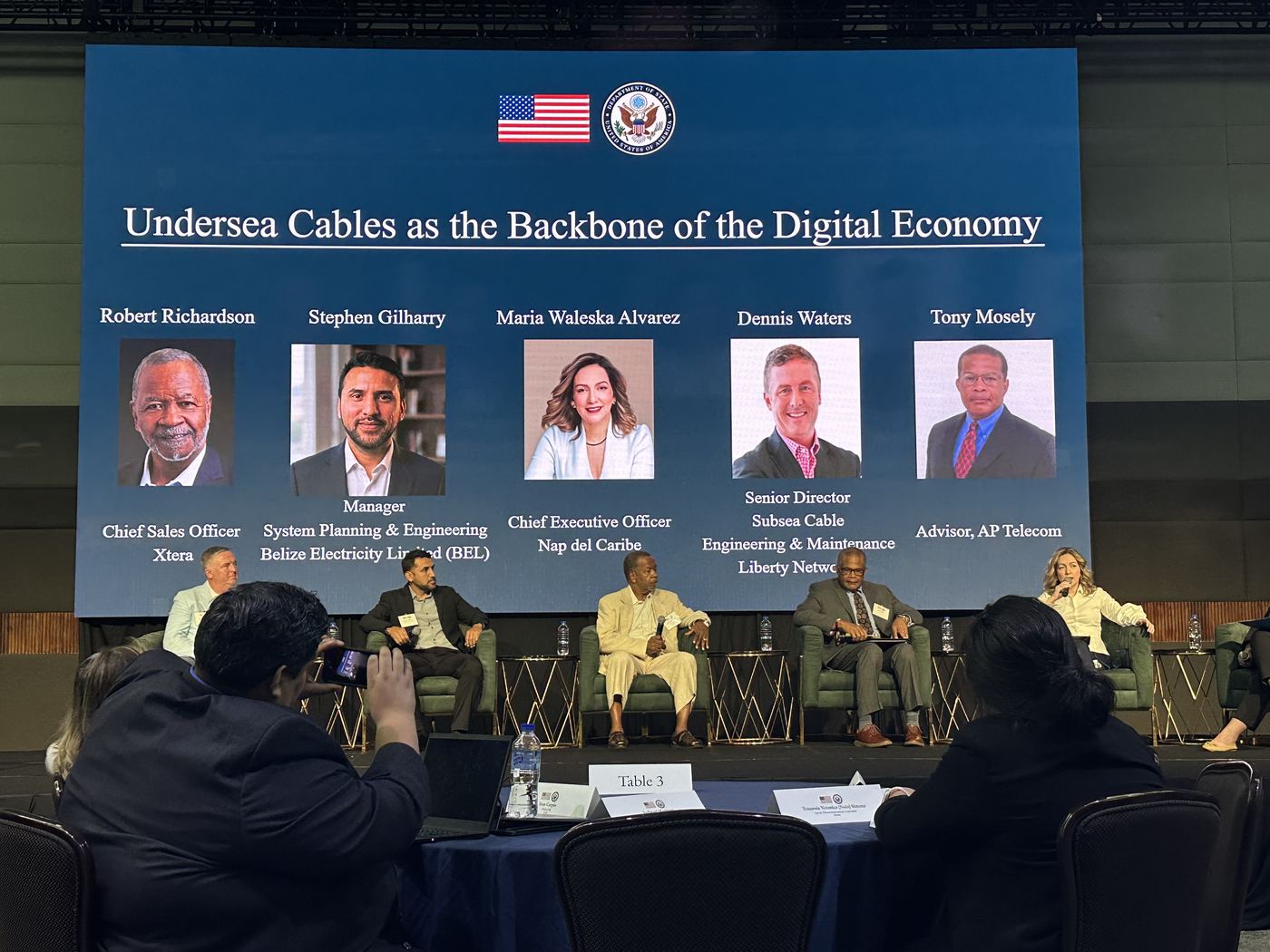 13:38 · Xtera, Belize Electricity, NAP del Caribe, Liberty Networks and AP Telecom.
Maria Waleska Alvarez gave the panel its thesis in one line, that connectivity today, alone, is no longer enough, and then supplied three gaps that explain why.
Three gaps
- Redundancy is illusory if multiple cables follow the same corridors and use the same cable types. Volume of cables is not the same as resilience.
- Landing stations do not create a digital economy. Cables have to connect into data centres, exchange points and actual ecosystems that convert capacity into economic value.
- The region plans nationally when individual markets are too small to matter. Combined, the Caribbean and Central America sit at the crossroads of the Americas and could be a serious digital hub.
Tony Mosely supplied the vivid version. He lived on an island served by a single cable for seventeen years; in the eighteenth the outage took down much of the economy, saved only partly by satellite. Compare roughly one hundred cable landings on the U.S. east and west coasts, where losing one changes nothing. His conclusion: the business case for island systems only closes if procurement is regional, blending subsea with LEO satellite and microwave.
Robert Richardson added the uncomfortable engineering fact. Apart from recent builds, most regional cables are around thirty years old, designed for voice, sitting on a single route, and not upgradeable any further, which keeps cost per bit too high to support modern services.
No fibre, no AI. It's that simple.Tony Mosely, AP Telecom
What this means for me
- "No fibre, no AI" is the line I will use in Georgetown, but Alvarez's point matters more to my business. Cheap transit is necessary and nowhere near sufficient. If the cables land and nothing gets built on top, the capacity just makes it cheaper for value to leave the country. The value layer is local, and it is the layer I work in.
- Guyana is uncomfortably close to Mosely's island. We depend on a small number of international routes, and much of what serves this region was engineered for voice a generation ago. Any service I build that must stay up when a route fails needs that assumption designed in, not discovered later.
- NAP del Caribe goes on my list as a concrete regional hosting option. A Tier III facility already running regulated financial, health and government workloads is a plausible home for AI workloads that cannot sit in a U.S. hyperscaler region for sovereignty reasons.
Advancing Secure Digital Connectivity in the Pacific Islands
Meghan Lefeber, U.S. Department of State
Tenanoia (Noia) Veronica Simona, CEO, Tuvalu Telecommunications Corporation
I did not record this session, so what follows comes from my notes and from Noia's own restatement of the Tuvalu model from the floor the following morning, where it landed, if anything, harder.
The core of it: ordinary people on remote islands cannot afford a satellite terminal subscription, even at around $75 a month. So rather than expecting households to buy service directly, the government invested in infrastructure that uses LEO priority terminals as backhaul into locally-run wireless access networks, then prices retail internet down to what people can actually pay, while still preserving a return that makes sense for the operator.
Ordinary people living in these remote islands cannot afford a terminal subscription, even at seventy-five US dollars a month.Tenanoia (Noia) Veronica Simona, Tuvalu Telecom, from the floor on Day 2
What this means for me
- This is a structuring insight, not a technology one, and the most directly transferable model I saw for Guyana's hinterland. The unit of purchase should be backhaul, bought once at institutional scale, not subscriptions bought individually by households that cannot afford them.
- It changes the assumption set for anyone building software for interior and riverine communities. You are not waiting for household connectivity economics to improve. You are designing for a community access network that already has usable backhaul.
Industry Matchmaking: fifteen minutes at a time
The matchmaking format was the reason to be there. Sixteen tables across two rooms, four fifteen-minute slots, delegations rotated against industry. Twelve tables were filled: Amazon Leo, AP Telecom, AST SpaceMobile, ATN International, CADMUS, Ericsson, Google, Liberty Latin America, Starlink, Xtera, NAP Caribe and Viasat. Guyana drew three of them.
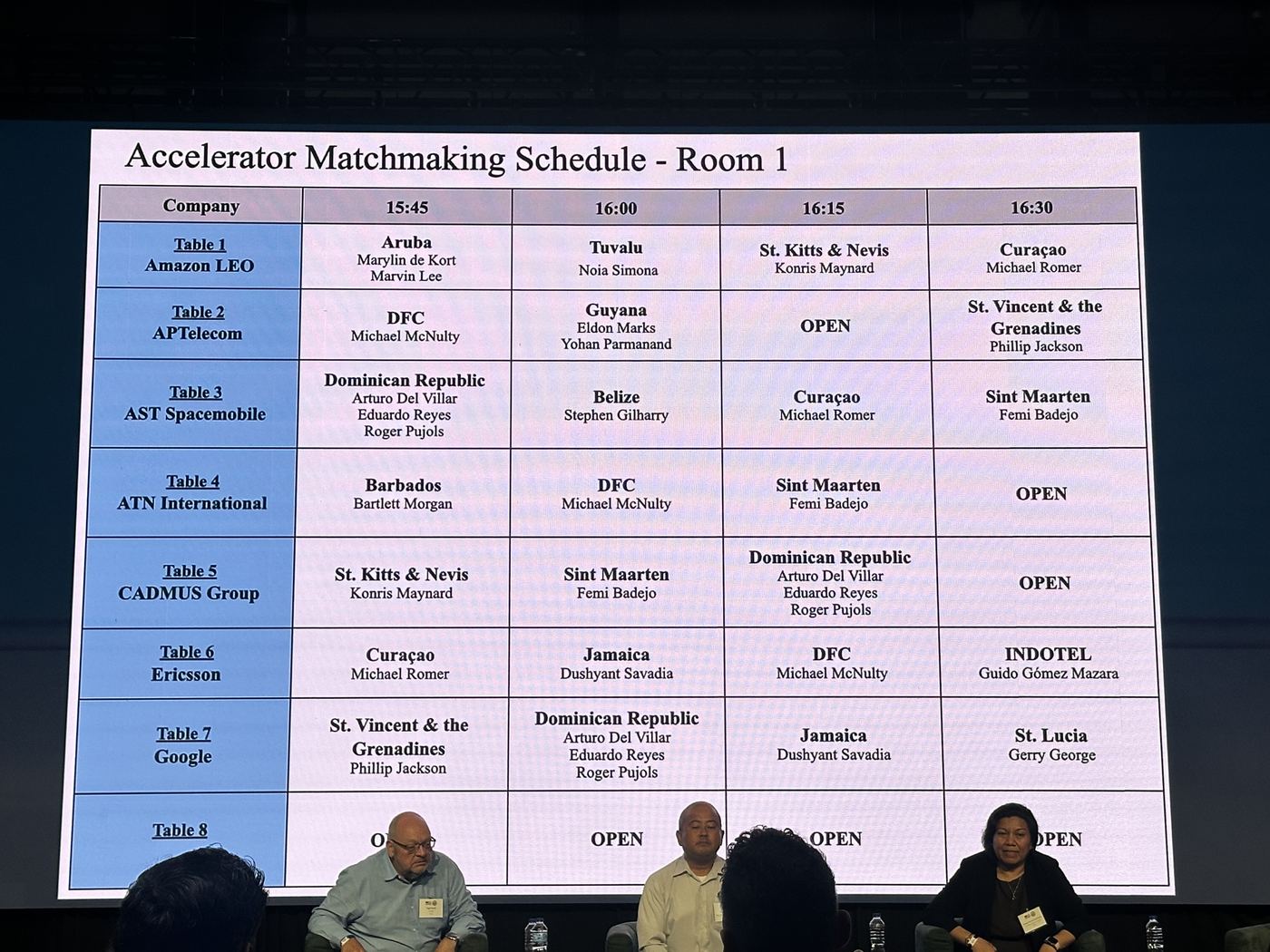 15:57 · Room 1: Amazon Leo, AP Telecom, AST SpaceMobile, ATN, CADMUS, Ericsson and Google.
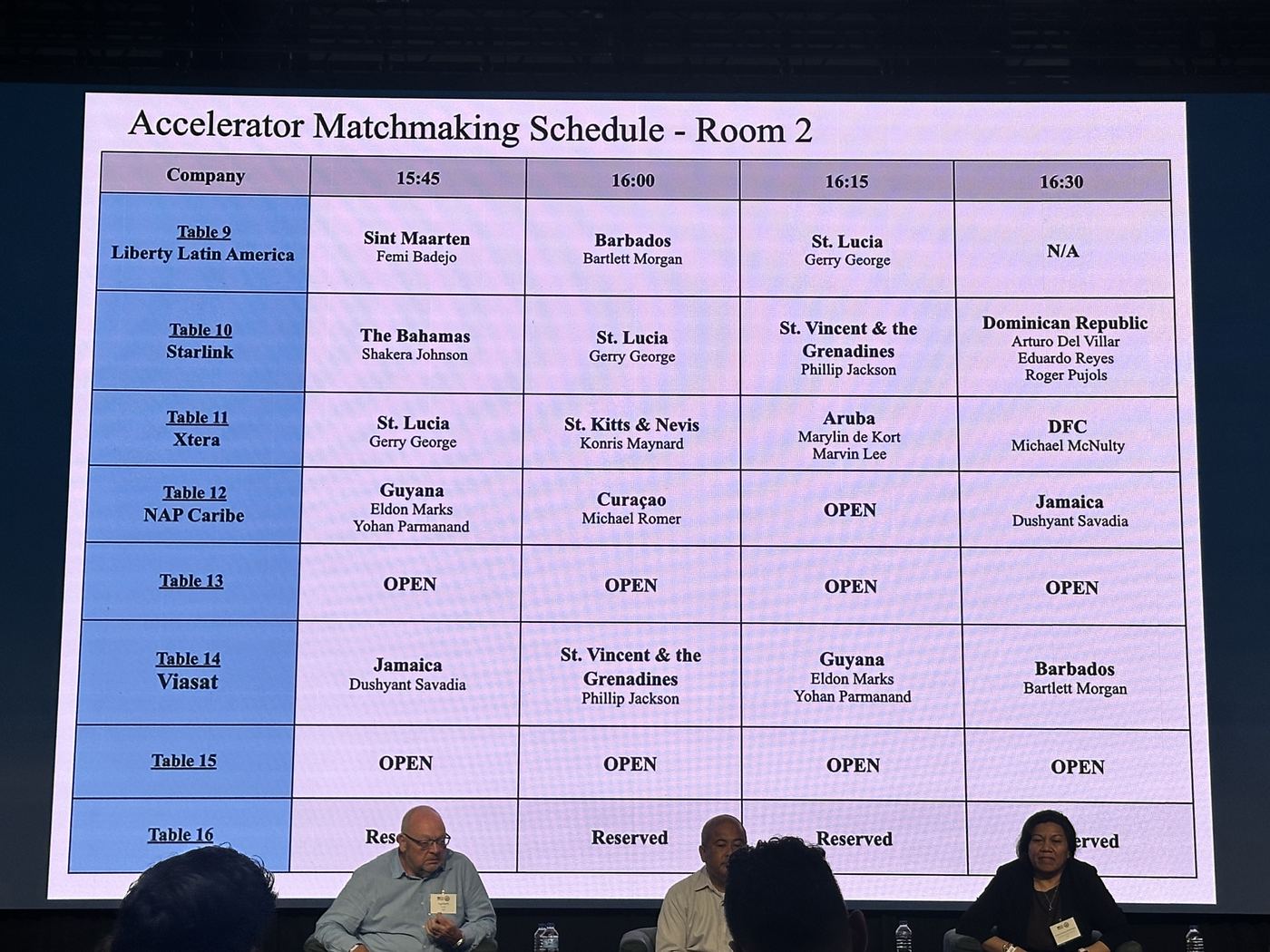 15:57 · Room 2: Liberty Latin America, Starlink, Xtera, NAP Caribe and Viasat.
AP Telecom: cables, sensing, and an anchoring purpose. Tony Mosely explained that AP Telecom assembled the coalition behind the Palau and Tuvalu cable projects in the Pacific, and suggested the same model could work in the Caribbean. His central point about islands was economic and slightly deflating. Demand and population usually fail the return-on-investment test for a cable on their own. Projects therefore need an anchoring purpose that pulls stakeholders together: an AI initiative, a digital health initiative, an education initiative.
When the conversation turned to Guyana's monitoring problem, exponential growth across oil and gas, mining, forestry and agriculture, each with environmental obligations the state cannot staff, he introduced fibre sensing. Distributed acoustic sensing along pipelines, water infrastructure, sewers and subsea cable, capable of classifying events acoustically: a backhoe, a vehicle, an explosion. His insistence was on the follow-through, the regulatory basis, the legal basis, and making outputs actionable. "You want useful tools, not just collecting information."
I put the AI question to him directly. Could generative and predictive models replace the fixed-calendar routine testing regimes the oil operators run, scheduling maintenance against actual metallurgical wear instead of the calendar, and could the same logic apply to a subsea cable with a twenty-five-year design life? He said they already do a manual version, using AIS ship-tracking to anticipate risk near cables and contacting vessels pre-emptively. He agreed to connect me with AP Telecom's CIO.
Viasat: sovereign capacity and direct-to-device. The longest and most unexpected conversation. Viasat already has a Guyana footprint through 19Labs, which has run telemedicine with the health ministry for a couple of years, plus substantial maritime and aviation business tied to Exxon's contracted vessels and rigs. The pitch was a national or regional sovereign satellite capability, already under discussion with CDEMA, CARICOM and the CTU.
The economics, as he put them
- There is no case for a tower in a village of fifty people. Satellite plus local Wi-Fi or LTE distribution is the answer.
- Equatys, a joint venture with UAE's Space42, will add a LEO constellation described as "a tower company in space".
- Direct-to-device chipsets ship today in Google Pixel 9 and Samsung Galaxy S25-class handsets, mid-range phones within about a year, effectively universal within five, with the sub-$100 handset the last holdout.
- Texting revenue is negligible even at a billion users. Value sits in IoT, connected cars, fleet management, and maritime and aviation safety, sold through local resellers and application partners.
- A long-running CTU "Smart Seas" project aims to protect small two-person fishing vessels that lose service beyond a certain distance from shore, where avoidable deaths happen in this region every year.
What this means for me
- Neither company wants to build the application layer. AP Telecom wants an anchoring initiative that makes a cable financeable. Viasat explicitly sells through local resellers, enterprise service firms and application partners. That is a template I can execute against.
- The Guyana opportunity is now concrete. Distributed acoustic sensing along pipelines and infrastructure, feeding a consolidated operations centre, with AI doing event classification and prediction. Real system, real vendor already deployed elsewhere, addressing a monitoring gap the state has openly admitted it cannot staff. Predictive maintenance against metallurgical wear rather than a fixed calendar is the second one, and worth more money.
- Anchoring purpose reframes how I talk to government. Instead of asking for infrastructure and then finding uses for it, position an AI or digital-health programme as the demand driver that makes capacity financeable. That puts a company like mine at the front of the conversation rather than the end.
 18:07 · The reception venue. A fair amount of the real business of these events happens here.
 21:34 · End of Day 1.
Day Two: Saturday, 8 August
From principle to capital. Who pays for this, on what terms, and what has to be true before the money arrives.
 07:59 · Day 2, Punta Cana.
Digital Modernization in the Caribbean: 5G Infrastructure and Beyond
Deputy Assistant Secretary John Mills, U.S. Department of State (moderator)
Adriana Servin Villada, Director of Government Affairs for Mexico, Central America and the Caribbean, Cisco
John Winter, General Counsel, Liberty Latin America
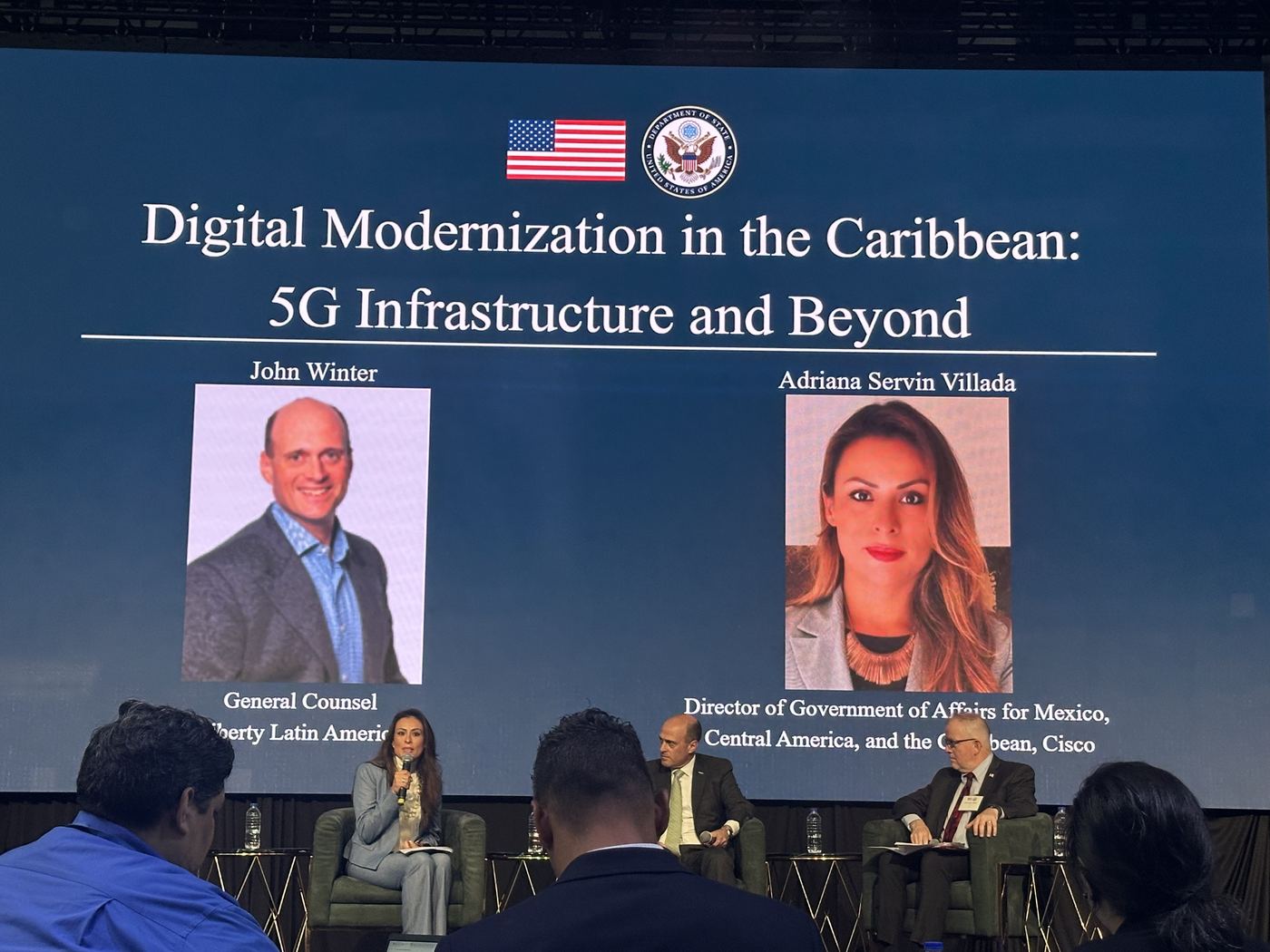 09:08 · Cisco, Liberty Latin America and the State Department open Day 2.
Cisco's argument: legal and regulatory certainty is the precondition for investment, and an AI strategy has to be built in parallel with a cybersecurity strategy, because attackers already use AI. She cited Costa Rica's 2022 attack and Spain's 2025 nationwide blackout as cascading critical-infrastructure failure, and Cisco's own AI Readiness Index finding that 51% of respondents said the absence of a clear legal framework limits AI adoption.
Liberty gave the operator's reality. Mostly 5G non-standalone so far, standalone in Puerto Rico with Costa Rica under way, launches in Cayman, Barbados and Jamaica. But Caribbean economics differ: small markets, low ARPU, equipment and build costs identical to large markets. Return on investment, not technology, is the binding constraint.
The best interventions came from the floor. One put the GSMA adoption numbers on the record. Another pushed the panel past connectivity for its own sake with the question the whole event needed: connectivity for what? A decade ago the conversation was about access; the paradigm since has been to maximise consumption. What would it mean to build for production instead?
The investment gap, in three numbers
- Roughly $1 billion of additional investment is needed for comparable regional coverage.
- Against about $4 billion of operator capex expected between 2025 and 2030.
- While industry revenues grow only from about $5.9 billion to $6.1 billion over the same period.
One of our largest sources of cost is power.John Winter, Liberty Latin America
What this means for me
- The revenue line should worry everyone. $4 billion of capex against revenue moving from 5.9 to 6.1 billion. That gap does not close by operators trying harder. It closes through sharing, regional aggregation, opex models, and someone else monetising the layer above the network. Which is the layer I work in.
- "Connectivity for what" is the question I want to keep asking at home. Guyana is about to have more capacity and more capital than ever. If all that produces is a larger consumption market, we will have imported the infrastructure and exported the value.
- Power keeps surfacing as the real constraint, and Guyana's bet on gas-to-energy sits directly on it. Every data-centre and AI ambition I have depends on that project working. That is a dependency, not a plan.
Bankability and Commercial Opportunities: Bridging the Investment Gap
Kim Tuminaro, U.S. Department of State (moderator)
Michael McNulty, Regional Managing Director, Central America & Caribbean, U.S. International Development Finance Corporation
Bryan Goldfinger, Senior Commercial Officer, U.S. Commercial Service, U.S. Embassy Santo Domingo
Alex Lih-Jiun Shyy, Deputy Secretary General, Taiwan International Cooperation and Development Fund
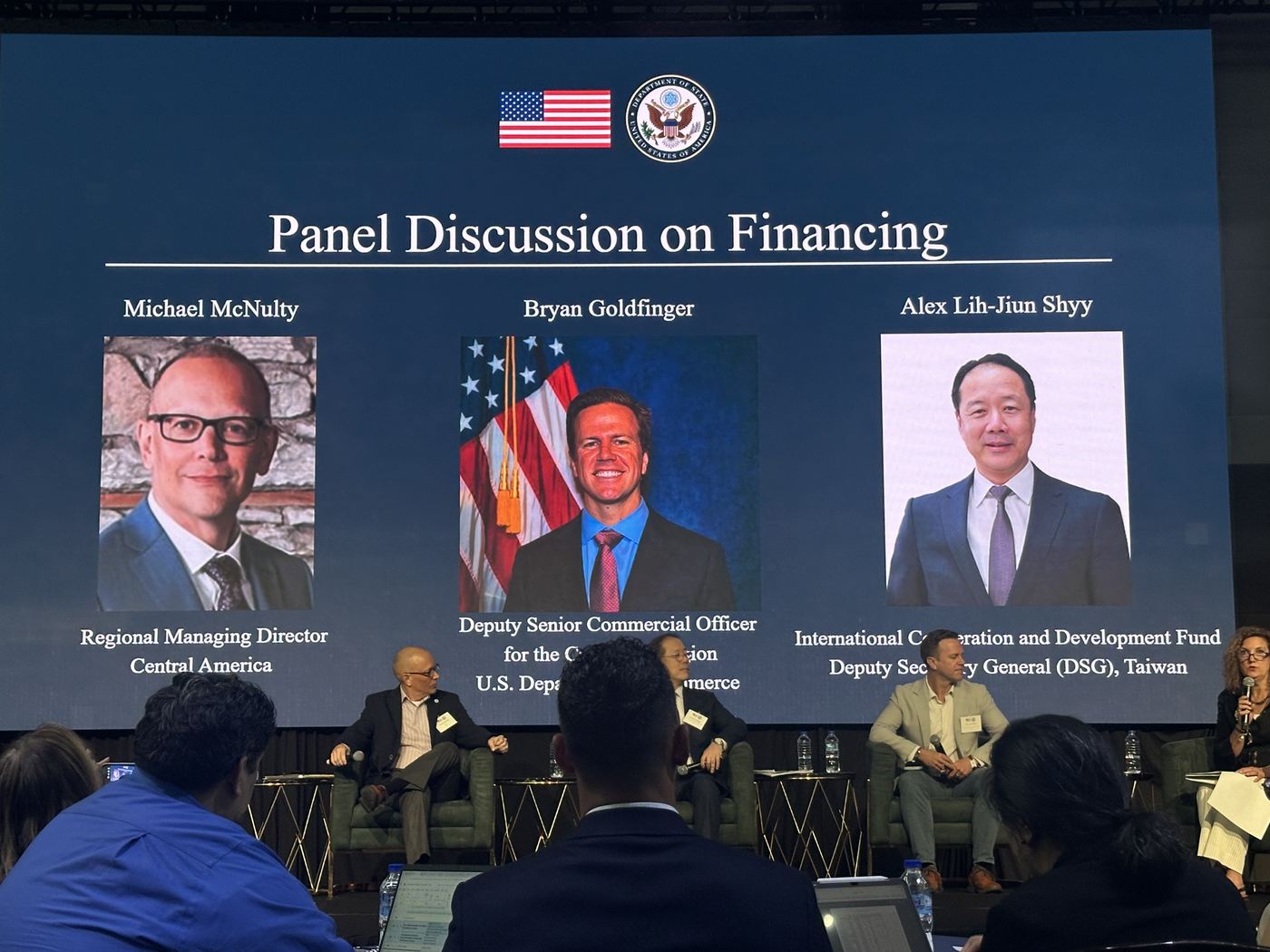 09:56 · The financing panel: DFC, U.S. Commerce and TaiwanICDF.
The session that turned two days of principle into terms and tickets. McNulty was disarmingly direct about what DFC is: a development bank supporting emerging-market investment aligned to U.S. foreign policy priorities, which has to be repaid. "Otherwise I wouldn't be doing my job correctly." Not grant money.
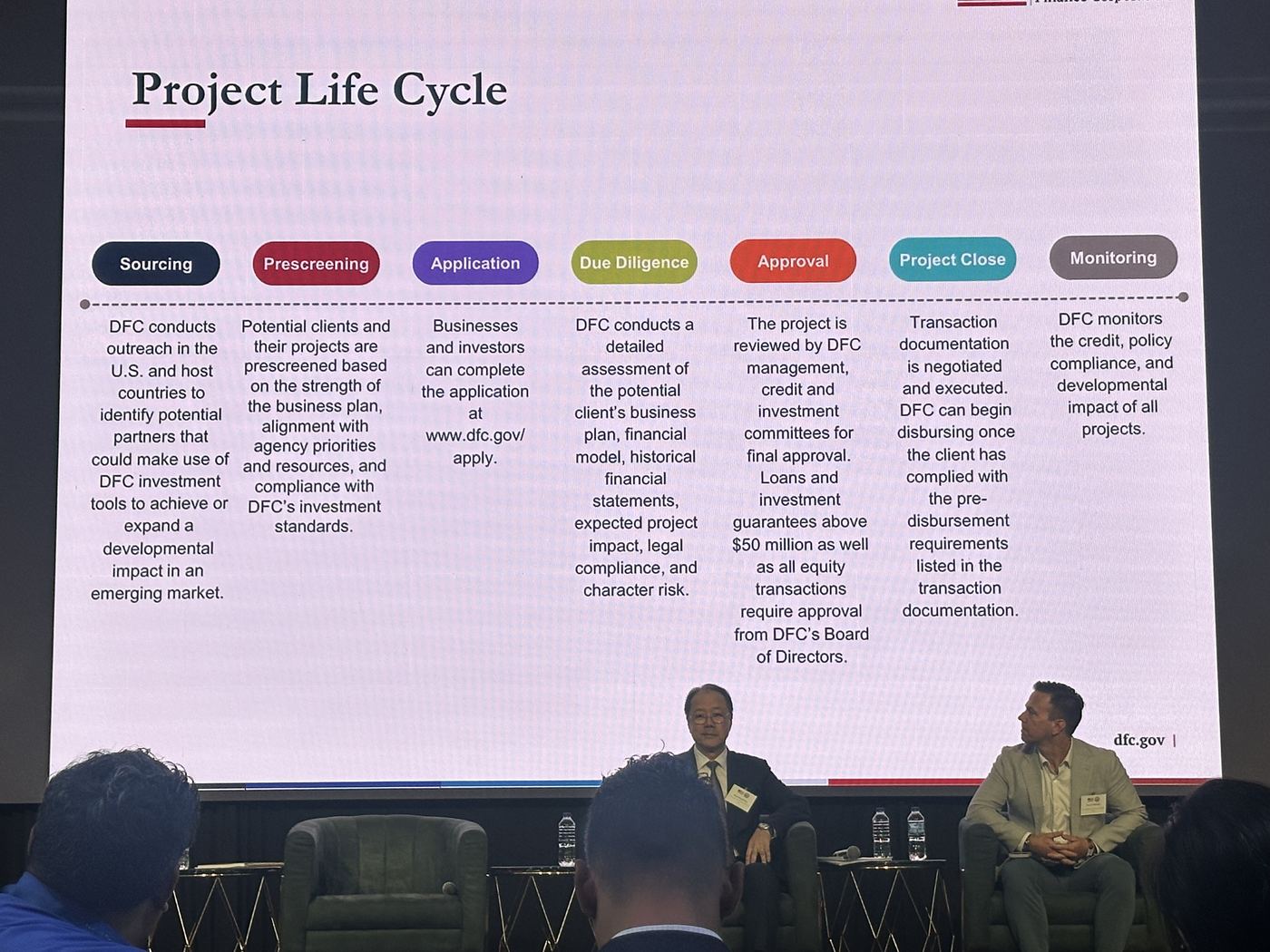 09:59 · Sourcing, prescreening, application, due diligence, approval, project close, monitoring. Typically four to twelve months.
DFC, in numbers
- Over $40 billion of exposure worldwide, approximately $11.8 billion in Latin America and the Caribbean.
- In the Dominican Republic: a $200 million credit line and a $40 million portfolio guarantee, both intermediated through local banks.
- Ticket sizes start at $5 million. Tenors up to 12, 15 or 20 years. Deal lifecycle typically four to twelve months.
- Six product lines: senior secured debt, mezzanine debt, equity, investment funds, political risk insurance, and project development support including feasibility studies and technical studies.
- Technology and telecoms infrastructure is a priority sector. He is actively reviewing several data-centre opportunities in the region and is open to subsea cable projects.
What they will ask you for, and what they will do for small markets
- Diligence checklist: a credible financial model and business plan; offtake or anchor-client agreements, meaning for a data centre, who is going to take up that space?; availability of international arbitration; and workable local security registries.
- Aggregate rollouts, expansions or acquisitions into a single larger facility rather than many small deals.
- DFC can guarantee up to 80% of a project, or take first loss, to a local or U.S. bank, in local or U.S. currency.
- Cash flows can be securitised to unlock domestic pension and insurance capital.
- The recurring blocker he named: gaps in local legislation are what stop capital arriving.
The agencies that were not in the room
- USTDA funds feasibility studies, technical assistance, pilots and front-end engineering design. "The first stop in the project pipeline", and the body whose entire job is making projects bankable.
- EXIM, established 1934, offers export credit insurance, foreign-buyer guarantees and direct loans, but eligibility (three-year exporter history, more than 50% U.S. content, shipment from the United States) is often hard to meet in ICT.
- The U.S. Commercial Service is export promotion, not financing. Commerce has also been designated lead for promoting exports of the full U.S. AI stack.
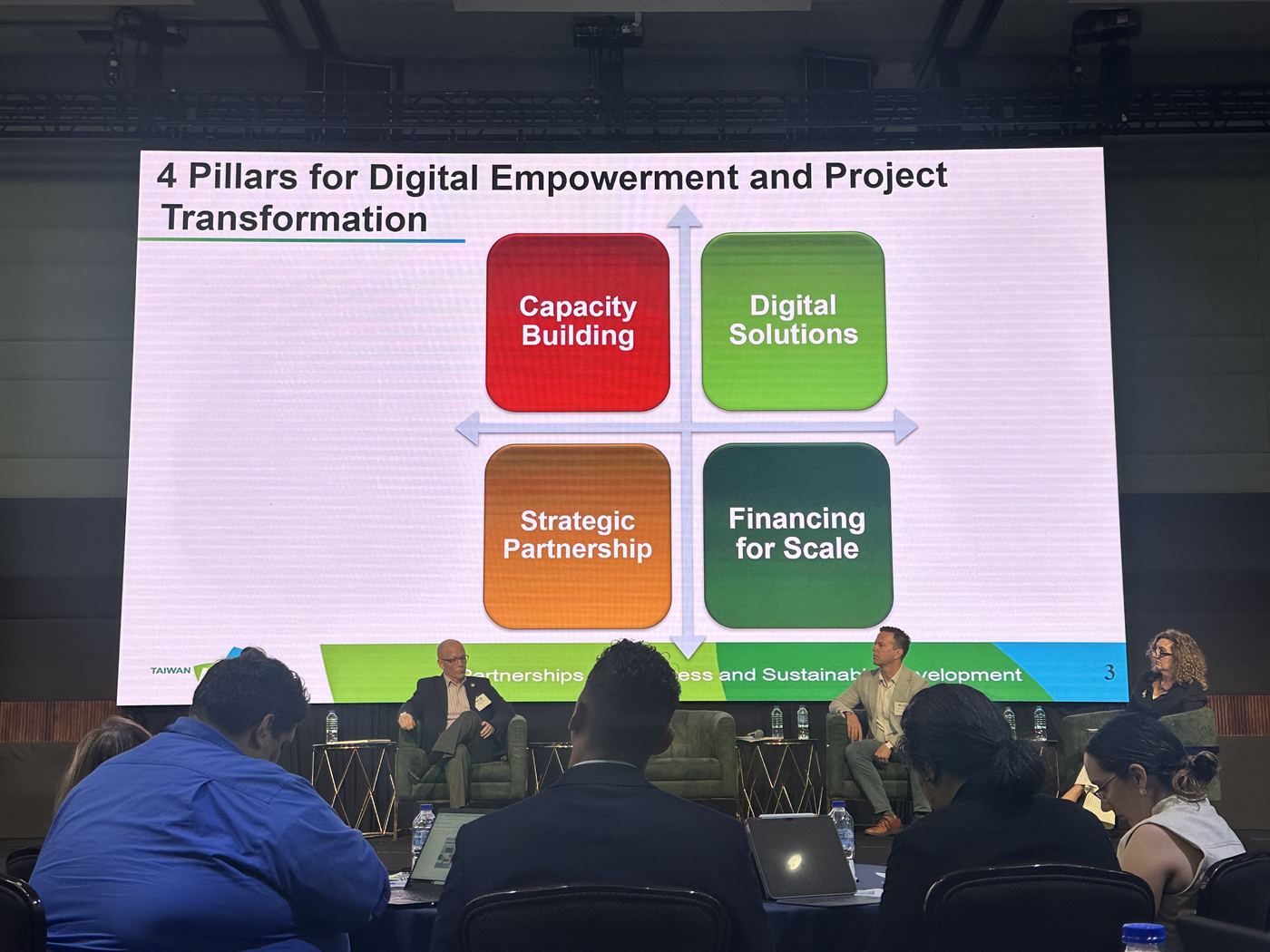 10:07 · TaiwanICDF's four pillars: capacity building, digital solutions, strategic partnership, financing for scale.
TaiwanICDF's case studies were the most concrete evidence in the room that this kind of money produces outcomes.
Then a newer Paraguay AI programme, built in layers: helping the ICT ministry draft national AI regulation; red-team and blue-team cybersecurity exercises for government officials; a digital acceleration centre matching startups and micro-enterprises lacking finance and market access to funding providers across six priority sectors; and a phased AI investment vehicle starting with government and development-partner co-investment before bringing in private and institutional capital.
Very soon some countries will face the problem of an AI divide, and its effect is far more serious than the digital divide.Alex Lih-Jiun Shyy, TaiwanICDF
What this means for me
- The Paraguay AI programme is the blueprint. Regulation drafting, government cyber capability, an acceleration centre linking startups and micro-enterprises to finance, and a phased investment vehicle that starts with public money and progressively crowds in private capital. A coherent national AI programme a small state can actually run, funded by a development partner already active in this region.
- On DFC, the $5 million floor puts direct lending out of reach at our stage, and I should be honest about that. But two doors are open: the project development window funds feasibility work before a project is bankable, and the aggregation route means borrowing at local bank level with DFC guaranteeing 80% so the local lender narrows its spread.
- "Who is going to take up that space?" is the question Guyana's data centre will face, and I do not think we have a good public answer. Anchor tenancy is the whole test. Government workload alone probably does not carry it; regional AI and compute demand might.
- His blunt diagnosis is the one to repeat at home. It is gaps in local legislation that stop capital arriving. Not appetite. Not geography. Law.
- With one qualification I did not have when I first wrote this. Of his four diligence questions, Guyana already answers two. It has been a party to the New York Convention since December 2014, so international arbitration is available, and the collateral registry under the Security Interest in Movable Property Act has been operational since October 2025. What is actually open for a Guyanese project is the financial model and anchor tenancy, and both of those are commercial problems rather than legal ones.
From Sea to Space: Low Earth Orbit Satellite Connectivity
Geoff Carr, U.S. Department of State (moderator)
Katie Flemming, Satellite Policy Analyst, SpaceX
Zach Blackburn, Licensing and Regulatory Lead for the Americas, Amazon Leo
David Tejeda Mendez, Latin America and Caribbean Regulatory Affairs, AST SpaceMobile
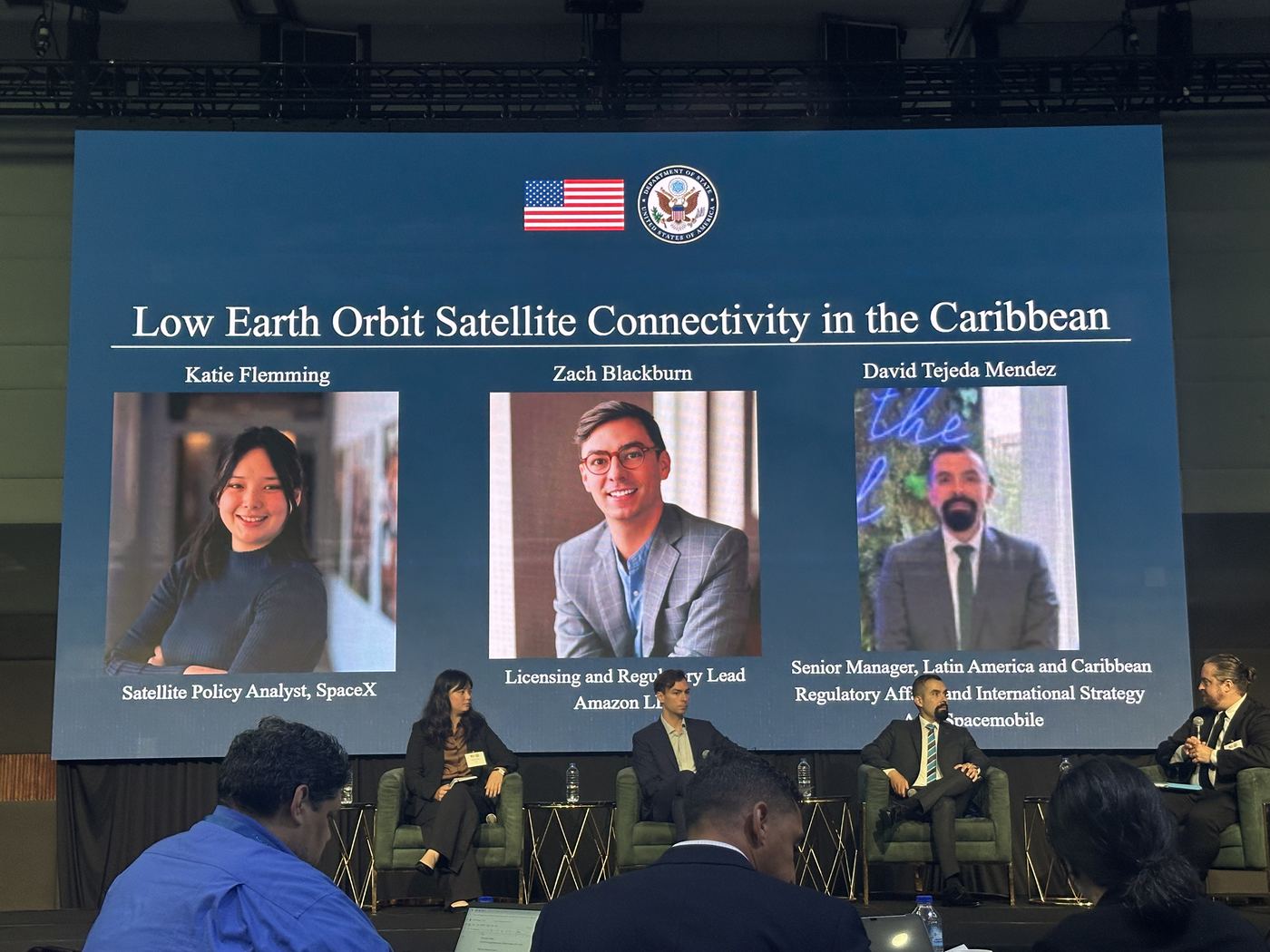 11:19 · SpaceX, Amazon Leo and AST SpaceMobile on the same stage, arguing the same regulatory case.
Three competitors, one consistent message. Satellite is complementary to subsea cable and terrestrial networks rather than a substitute, and the binding constraints are now regulatory rather than technical.
SpaceX made the abstraction concrete, and this was the most affecting material of the day. Starlink serves about 150,000 Caribbean subscribers, an estimated 450,000 individuals, around 57% outside urban areas. In one hurricane response it worked with Flow and the national regulator to deploy direct-to-cell to over 140,000 devices. In Venezuela, thousands of users coming online at once in a small area hit EPFD throttling, until relaxation authorisations came through from Venezuela and Colombia and service improved overnight. Any country can grant that pre-emptively, before the disaster, rather than negotiating during one.
We are a partner. We are not a competitor.David Tejeda Mendez, AST SpaceMobile
The regulatory asks
- Streamlined licensing: blanket licensing and open skies rather than landing rights, with the Bahamas' recently completed consultation and CITEL's technical note offered as models.
- Modernise EPFD limits. The FCC granted relaxed authorisations in January and March, and similar exist in several Latin American countries, with no reports of interference.
- No separate full licence for a satellite extension of a terrestrial network, and no duplicate spectrum fees for a band already licensed to the mobile operator partner.
- No mandated in-country gateway when the system is designed around regional gateways, and one licence per system rather than element by element.
- Implementation lag was a recurring complaint. WRC-23 agreed rules for earth stations in motion in Ka-band, and three years on many countries have not implemented them domestically.
What this means for me
- Pre-emptive EPFD authorisation is the cheapest policy win available to any Caribbean government, and I had not understood it existed. It costs nothing, it has been granted elsewhere with no interference reported, and the alternative is discovering during a flood that your emergency connectivity is being artificially throttled.
- LEO backhaul plus direct-to-device changes my hinterland timeline. I had been designing on the assumption that interior and riverine coverage was a decade away. If mid-range handsets carry direct-to-device within a year and coverage is effectively universal within five, then edge and hinterland AI deployments are a near-term product question.
- Three constellations competing in this region is good news for anyone selling software rather than bandwidth.
Emergency Communications Lessons Learned
Geoff Carr, U.S. Department of State (moderator)
Oronde Lambert, ICT Manager, Caribbean Disaster Emergency Management Agency (CDEMA)
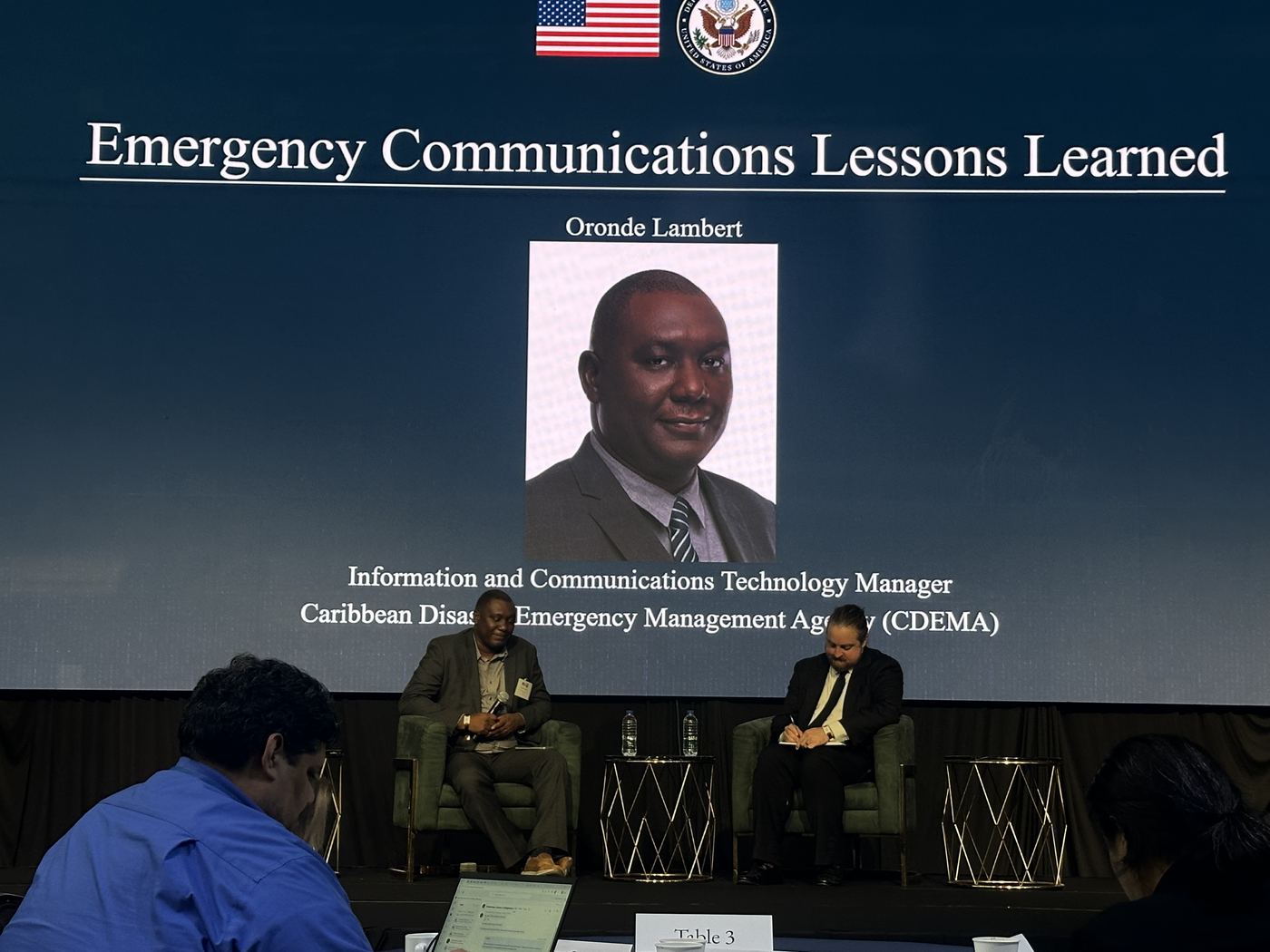 13:17 · CDEMA's Oronde Lambert on what the region has actually learned from responding.
CDEMA has to make everything discussed over the previous day and a half work under the worst possible conditions, and Oronde Lambert's account was the most operationally honest hour of the two days.
CDEMA is an intergovernmental body of CARICOM with around twenty Participating States. Everything runs through the Regional Response Mechanism, hubbed in Barbados. The lessons-learned part was a story about economics as much as technology. After two devastating Category 5 storms, after-action reviews showed regional ICT response had to be strengthened, so CDEMA stood up a small deployable communications team, typically four people, to restore connectivity at the impacted state's National Emergency Operations Centre. Legacy BGAN-type terminals served an individual or a small team and no more; a formal tender came back well over budget. Starlink arrived at a price point that worked, and the consequence was not better bandwidth so much as more kits, and therefore more teams deployed simultaneously.
In a nutshell, satellite has been a game changer for us.Oronde Lambert, CDEMA
Then the candid part. The problem during Hurricane Melissa was not the kit. So many donated Starlinks were on the ground in Jamaica that nobody knew who had what or where: clusters in some parishes, nothing in others, responders treading on each other. SpaceX donated equipment and gave impacted states about three months free, which is generous and also a logistics problem, because a lot of those kits now sit idle with nobody to pay for service.
Friction that is still unsolved
- Customs clearance of response equipment, country by country, in the hours when it matters most.
- Divergent national drone rules. In Barbados a drone cannot be brought in without special authorisation, and drones have been confiscated. CDEMA's response is a "UAS for CDM" programme to certify a standardised regional cadre of operators.
- Spectrum fragmentation for private LTE, which CDEMA is taking up with the Caribbean Telecommunications Union and ECTEL.
- Starlink is not licensed everywhere in the region, so the fallback is not uniformly available.
- His headline ask: a regional satellite arrangement rather than country-by-country deals. Individually these states have no negotiating leverage. Collectively they would.
His top three needs, which read like a product brief
- Situational awareness. Knowing which assets and responders are actually on the ground.
- Information management. Making many disparate systems work together efficiently.
- Pre- and post-event analysis from satellite imagery, which requires member countries to supply baseline infrastructure data first.
What this means for me
- His top three are a product brief, and I do not think he meant them as one. Those are software problems, not satellite problems, and the satellite layer he needs already exists. The gap between connectivity being donated and coordination being absent is the most concrete unserved need I heard in two days.
- Melissa is a warning about how this region receives help. Equipment arrives, generously, and the failure happens at the coordination layer where nobody has funded anything. Hardware gets donated, software does not, and the software is where the leverage is.
- Test against a grid-failure standard, not a good-weather one. For Guyana that is not a hurricane scenario, it is an ordinary Tuesday.
Building Towards an AI Future
Kim Tuminaro, U.S. Department of State (moderator)
Dushyant Savadia, Founder and CEO, Amber Group, Jamaica
Malachi Hernandez, Founder and CEO, Ipelint
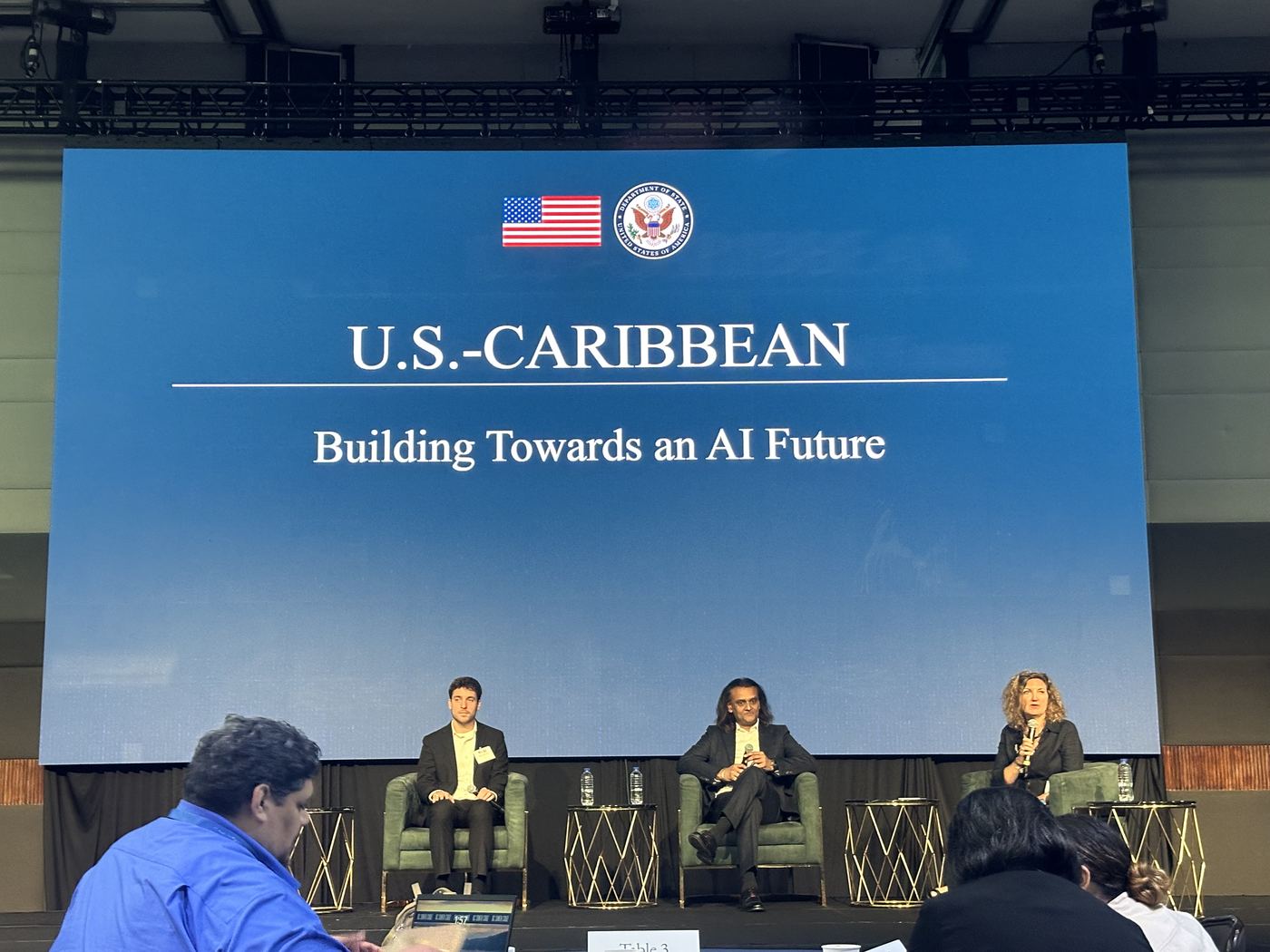 13:58 · The last panel of the Accelerator.
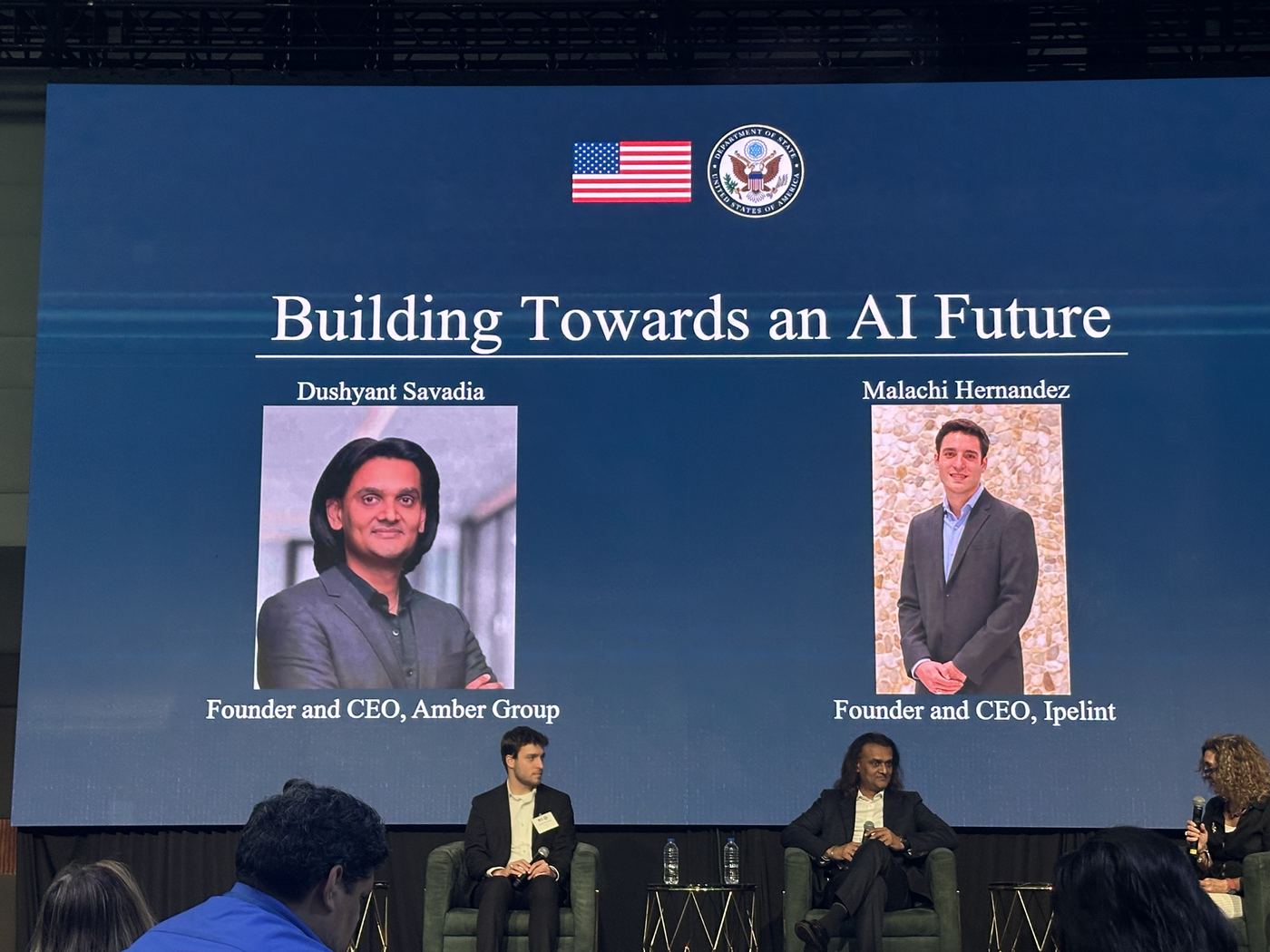 14:03 · Two founders rather than two policymakers, a deliberate choice and the right one.
Kim Tuminaro opened with the U.S. policy frame. AI as a fundamental strategic asset, not a single technology but an integrated capability resting on compute, data pipelines, talent and networking infrastructure. She set out instruments rather than sentiment: the American AI Exports Program, established by executive order last July; EXIM's AI export initiative launched in May, financing full-stack American packages; AI standards workshops run in Argentina and Mexico; and an AI summit hosted by the U.S. Embassy in Lima in September, floated as a template for a Caribbean equivalent.
Dushyant Savadia's diagnosis: the region's four constraints have to be solved together, skills, connectivity, data and data-centre capacity, and cybersecurity, because fixing one and leaving three is not progress. He described Amber's AI national lab, launched in Jamaica the month before, and proposed a shared CARICOM AI data centre on the grounds that no individual Caribbean state can afford its own.
There is no point bringing AI into the country when the people are not yet skilled enough to operate it.Dushyant Savadia, Amber Group
Malachi Hernandez put infrastructure and energy first, and made the most usefully contrarian point of the session. The concentration of data centres and know-how in the United States is actively pulling students out of the Dominican Republic and the wider region. On 6G he noted China holds roughly half the relevant patents. And he built Ipelint first as an OpenAI wrapper to ship an MVP, then rebuilt on his own layered models, finding many steps cheaper, faster and more secure as plain deterministic code.
I'll say something potentially a little controversial: sometimes AI is not the best solution for the problem at hand.Malachi Hernandez, Ipelint
The Q&A: my intervention
The panel left about twenty minutes for discussion, and I took the floor first. What follows is what I said, cleaned of the usual verbal debris but otherwise as it was.
Eldon Marks · V75 Inc. / TrueSelph, Guyana
I've built AI companies, AI teams and AI products since 2018, and there are a few things I'd like to contribute to the conversation.
The first is that, from a practitioner standpoint, the AI industry is really just under four years old. A cursory look at what's happening in the news tells you that companies are still figuring themselves out when it comes to AI. The reason I raise it is the pivot we had to make on the heels of ChatGPT's debut. At that point we had to scrap everything we knew about building AI. We had started in 2018, and we had to reskill, retool, rebuild. It was an organic process. We made a lot of mistakes, but in doing so we discovered quite a bit.
I'd like to go back to what was presented earlier about innovation over regulation, because I think that's right. The region in particular, and the world over, will need to take a practitioner's approach. When it comes to AI, discovery is absolutely essential, given the nature of the technology, because it's nothing like we've seen before, and I've been in tech for over two decades. The thing about AI is that the technology clearly outpaces human imagination, our ability to understand it and keep up with it, because it grows so exponentially.
So what I'm recommending is that, regionally speaking, and I heard the ministers are actually exploring these avenues, there needs to be innovation activity around AI where actual use cases are explored. SMEs are perfect for that. They help practitioners reskill and understand the technology natively, by taking their real use cases and applying the tech through trial and error until you discover what it genuinely can and cannot do.
We've taken a lot of companies along that journey over the years, and what we found is a clear gap in AI literacy. It isn't about dropping technology onto a problem, because, as I said, this is nothing like we've seen before. You need an AI literacy foundation first. Then you need a mapping between the actual operations of the organisation and the technology. Then you need evangelism inside the organisation. Then you pilot. Then you scale.
To contribute something concrete: in 2023 we worked with IDB Lab to design an AI enablement programme targeting 15 local organisations and companies. We were building the harness, the software around these models, while simultaneously serving the use cases we were discovering. What came out of it taught us a great deal about what AI can and cannot do from a practitioner standpoint, setting aside the largely hypothetical discussions you hear at forums across the region. We got down to the actual can and can't. And beyond that, it sensitised the people we worked with and demystified AI for them, which created a pull effect locally in Guyana.
All of which is to say that the straight and narrow path to building towards an AI future is a practitioner's approach. The technology isn't like anything we've seen. We need innovation hubs that let us explore it, make mistakes, and regroup from there.
My final point is the other side of this. As a tech company, AI is disrupting jobs. Fifty per cent of our workforce has been all but absorbed by AI. That worries us, because we set out to create opportunities. But there's another side of AI that can offset the disruption, and I'd like to put it on the table: the one-person AI company. A programme that gives a single individual enough of a foundation and enough tooling to take an entrepreneurial path and make a living, leveraging AI. Thank you.
Savadia took the response, and it became the most substantive exchange of the session. He opened by noting he was heading to Guyana and already works closely with some of the large corporates there, then reframed the workforce point. The Caribbean does have a workforce problem, and while Jamaica's BPO sector employs forty to fifty thousand people and does well, ordinary small and medium businesses struggle because they cannot afford to hire in the first place.
His reply, in five parts
- Innovation labs are absolutely essential, and that is precisely why Amber designed its lab the way it did. Six months of hardcore fundamentals before anyone builds anything, then business cases aimed at government services, because that is where the friction is. Everything requires standing in a queue.
- On job disruption, his own numbers. Nearly 1,500 in-house software engineers across Jamaica, Dubai and India, AI-trained for two to three years. They have stopped hiring. Instead they give each engineer more laptops so they can run multiple agents concurrently. Work that took twenty people six months now takes two.
- The optimistic reframe was quality of life, that the point is for people to go home at five without dread, but he was clear it requires a large education curve delivered through proper innovation centres.
- On hypothetical discussion, a story about one Caribbean country taking five years to produce an AI policy that ChatGPT could draft in minutes, with human judgement then used to refine and de-bias it.
- On SMEs, what Amber is shipping. "AI in a box", around thirteen affordable tools for small businesses, including a legal and compliance model loaded with Caribbean law, because lawyers start at $400 an hour and small businesses sign contracts they do not understand.
We have no problem giving our data to Facebook and Instagram and LinkedIn, yet we are so afraid to give our data to government services.Dushyant Savadia, Amber Group
The last question came from the telecoms side of the room and was a useful corrective. GSMA data has 38% of Caribbean mobile operators having introduced exactly one AI tool, almost always a customer-service chatbot, and only around 3% deploying AI anywhere else operationally, with cybersecurity exposure from putting agents into carrier networks given as the reason for the caution.
What this means for me
- The abstraction level drops the moment a practitioner speaks. I said in the room that the AI industry is under four years old and everyone is still figuring it out, and the value was watching how fast the conversation moved once someone with delivery scars put a marker down. That is a role worth occupying deliberately rather than occasionally.
- Savadia's answer gave me the shape of a partnership. He is building the education layer at scale and he is heading to Guyana. I am building the enablement layer for organisations that already exist. Complementary, not competitive. Between the Amber lab model and what we learned running the IDB Lab programme with 15 Guyanese organisations, there is a joint proposition neither of us has alone.
- The number that stayed with me is his: 1,500 engineers, hiring stopped, twenty people over six months compressed into two. Same curve I described from our side, half our workforce absorbed, at twenty times the scale. It confirms the one-person AI company is not a soft social proposal. It is the only serious answer I have heard to what happens to technical employment in a market this size.
- The GSMA number is a market, not a caution. 38% of regional operators have deployed exactly one chatbot, 3% have gone further, and the stated blocker is security rather than value. A well-defined buyer with a well-defined objection, and answering it with auditable, governed, on-premise-capable agents is squarely what we build.
Incubator Time
Stanley Greidinger, Economic Officer, U.S. Embassy Santo Domingo
The programme ended not with a keynote but with an exercise, which was the right instinct. Delegations were put into a scenario and made to negotiate it out loud.
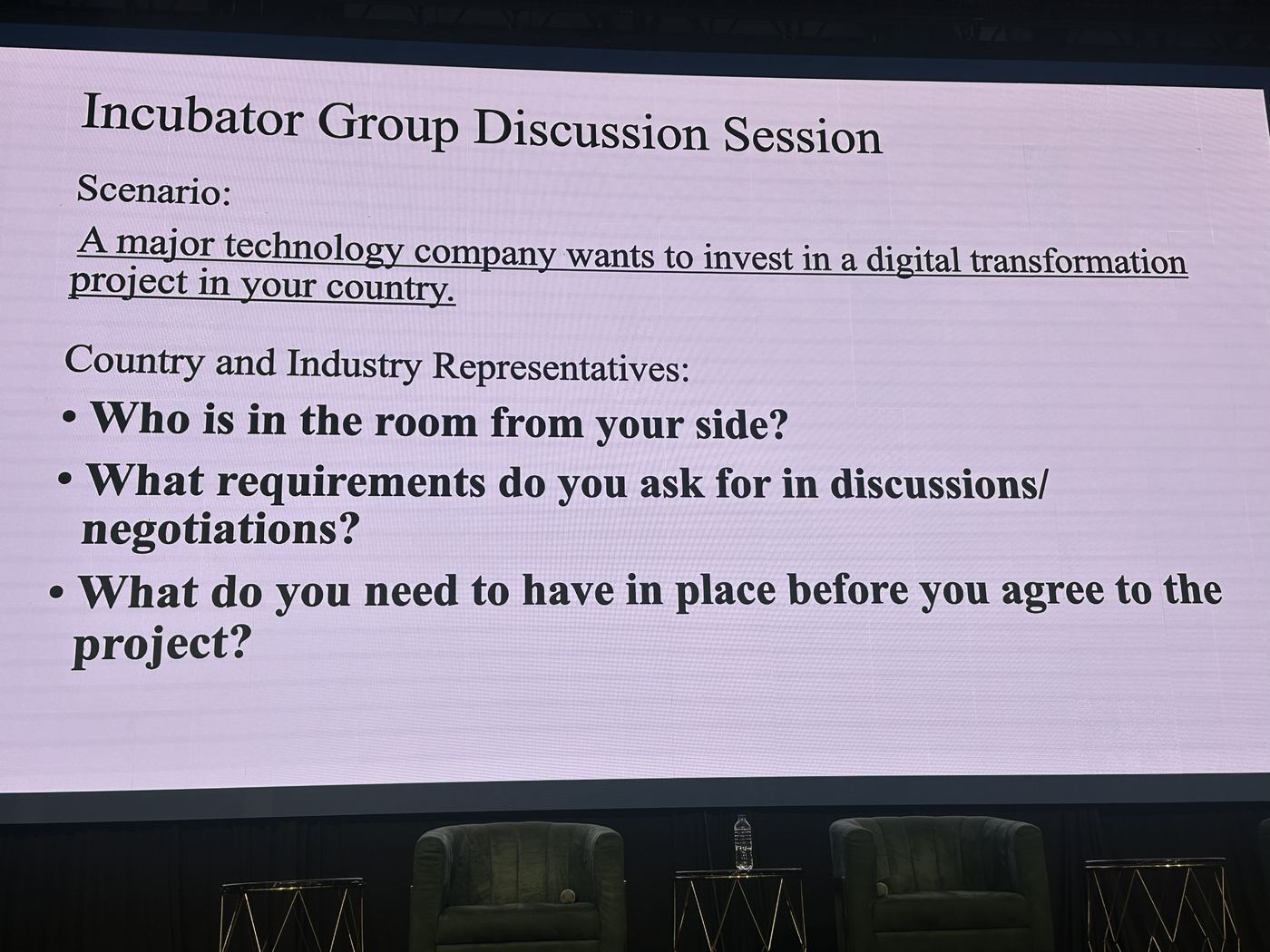 15:38 · The scenario: a major technology company wants to invest in a digital transformation project in your country. Who is in the room from your side? What requirements do you ask for? What must be in place before you agree?
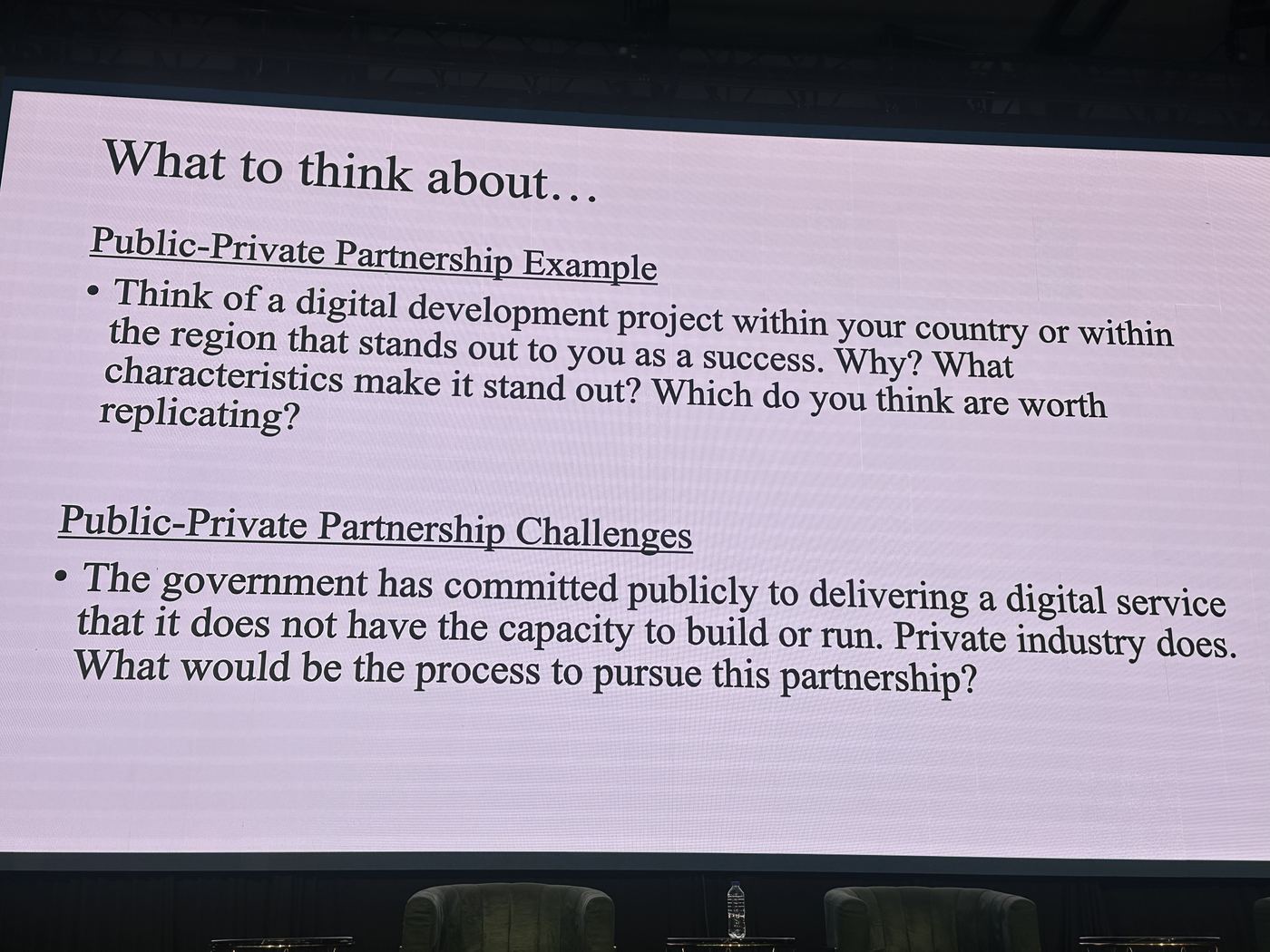 15:39 · The follow-on prompts pushed harder, ending on the uncomfortable one: the government has committed publicly to delivering a digital service it does not have the capacity to build or run, and private industry does. What is the process to pursue that partnership?
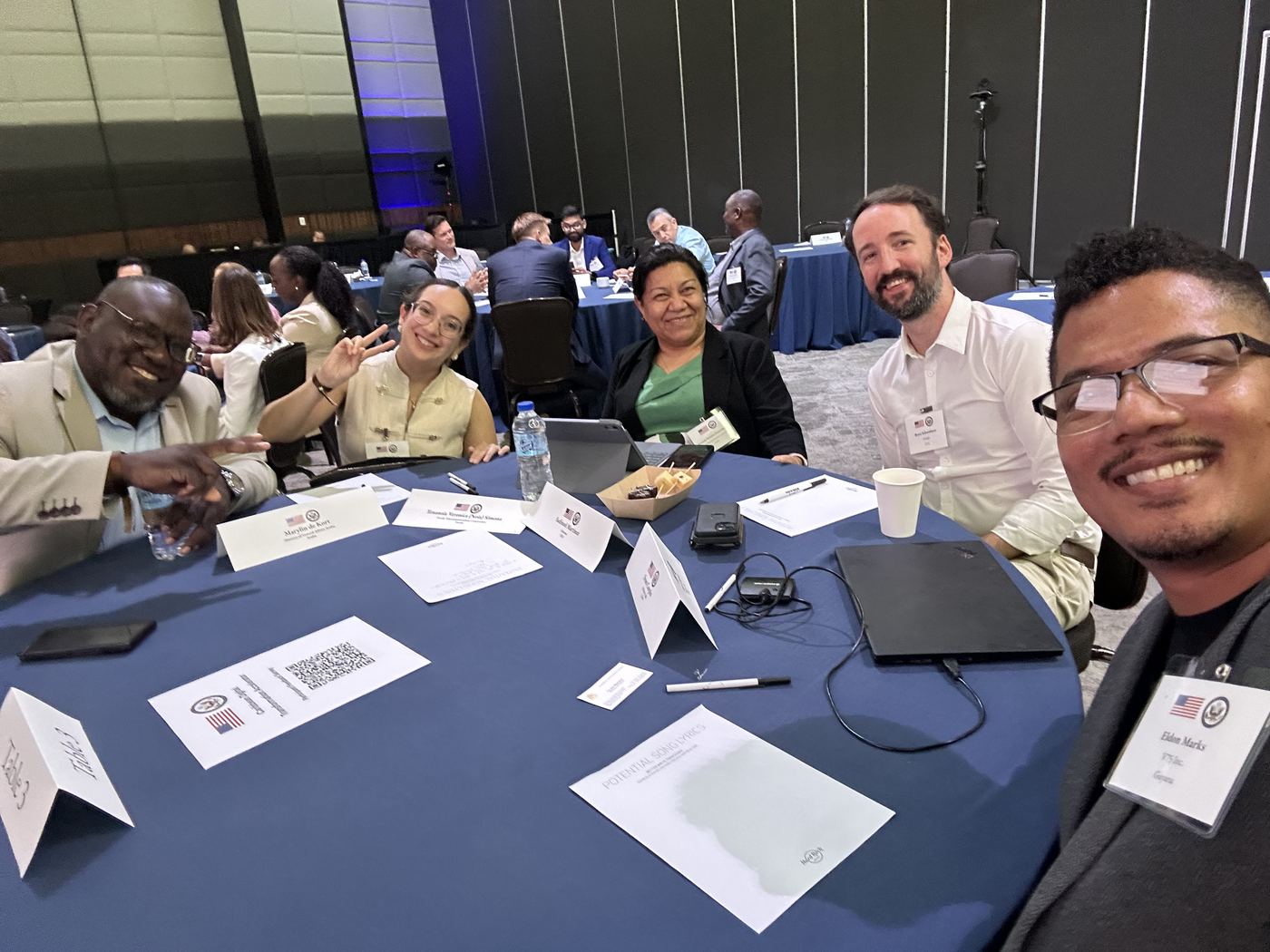 16:00 · Table work. Delegations from Aruba, Saint Vincent and the Grenadines, Guyana and others, arguing it out.
What this means for me
- That last scenario is not hypothetical anywhere in this region, and certainly not in Guyana. Government announces a digital service, lacks the capacity to build or run it, and industry has that capacity. What happens next determines whether the announcement becomes a system or a press release.
- The recurring answer across the tables was that the process has to be defined before the commitment is made, not after, which is the opposite of how it usually goes. For a company on the industry side, the lesson is to be in the room early enough to shape the requirement, and to answer the "what must be in place first" question better than the person asking it.
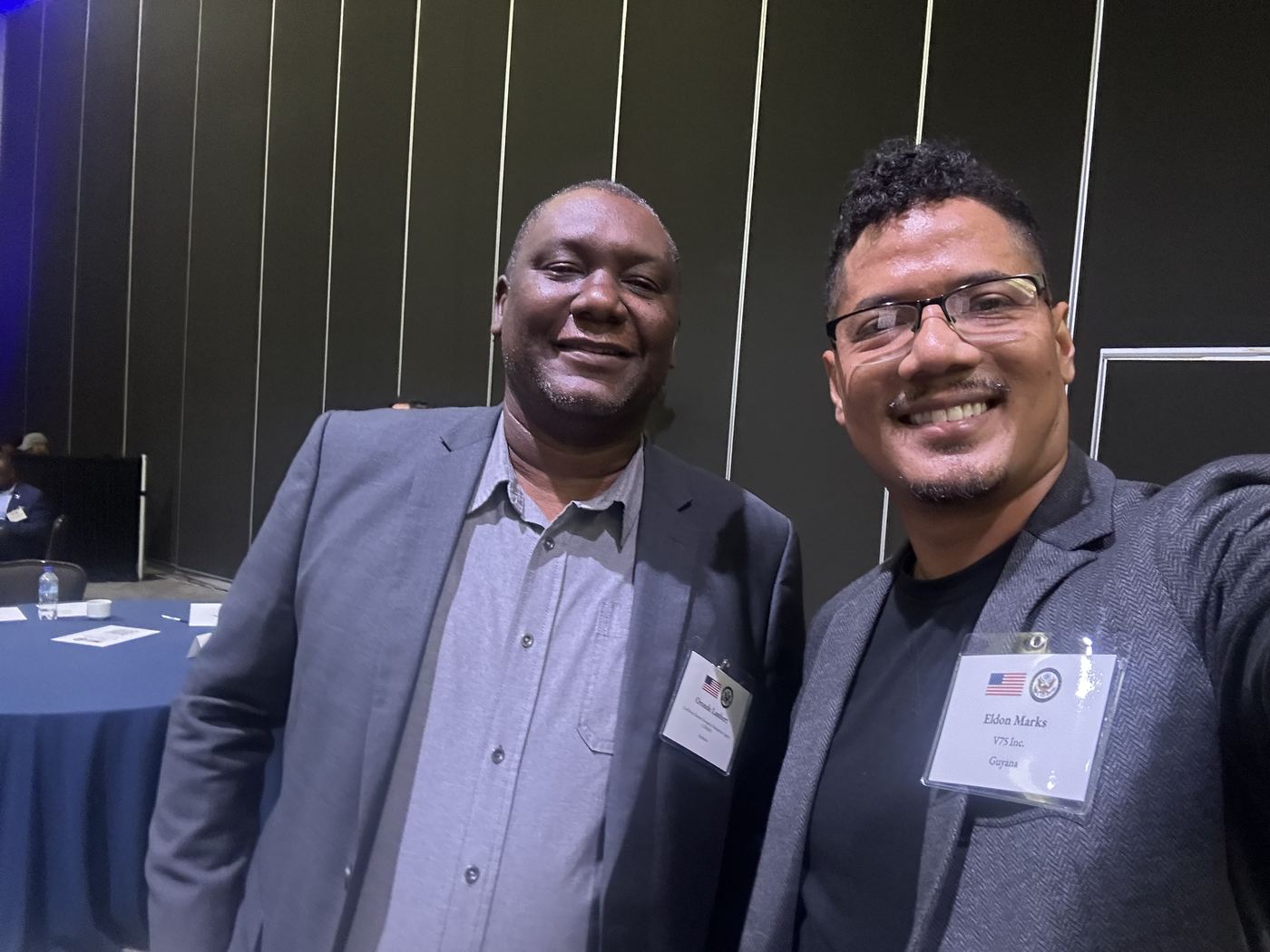 With CDEMA's Oronde Lambert. Most of what these events are for.
Where this leaves me
I went in expecting connectivity policy and came out with a work plan. Three things changed how I am thinking.
First, the infrastructure argument for AI has already been won, and I did not have to win it. AI was named in the opening remarks as justification for nine to fourteen billion dollars of regional investment. Cisco argued AI strategy and cybersecurity strategy must be built together. TaiwanICDF warned that an AI divide will be worse than the digital divide. AP Telecom reduced it to "no fibre, no AI." I no longer need to persuade anyone in a regional forum that this matters. The scarce thing is people who can actually build and ship, and that was visible in the room.
Second, the money is more accessible than it looks, but only in specific shapes. DFC does not write cheques below five million dollars, and pretending otherwise wastes everyone's time. But the project development window funds feasibility work before a project is bankable. USTDA exists specifically to make projects bankable. DFC will guarantee 80% of a local bank's exposure rather than lending directly. TaiwanICDF runs acceleration programmes matching startups and micro-enterprises to finance. Four or five real routes, each with a named person attached who was in that room.
Third, the constraint is law and legitimacy, not technology. This was said in almost every session by people with no reason to coordinate. Costa Rica's decree survived because it was anchored in standards. The DFC's regional managing director named legislative gaps as what stops capital arriving. Liberty's asks were all regulatory. The satellite operators' asks were all regulatory. In Guyana we have oil money, a data centre under construction and a gas-to-energy project, and a legal and policy framework that has not caught up with any of them. That gap is where the risk sits, though it is narrower and more specific than I first put it. Some of what a financier asks for is already in place, and a good deal of what the satellite operators want looks like subsidiary legislation rather than an Act of Parliament. The constraint is real. It is simply more tractable than "reform the framework" makes it sound.
What I am actually doing next
- Follow up with the Dominican Republic's Ministry of Industry, Commerce and MSMEs on the OAS-backed SME AI pilot and the tech ambassador model, and scope a Guyanese version with our university partners.
- Take the introduction to AP Telecom's CIO, and develop distributed acoustic sensing plus AI event classification into a real proposal for Guyana's environmental and infrastructure monitoring gap.
- Work up the predictive-maintenance case, condition-based rather than calendar-based testing, for the oil sector and, more speculatively, subsea cable maintenance.
- Get the full design of TaiwanICDF's four-layer Paraguay AI programme and work out what a Guyanese equivalent would cost and who would fund it.
- Raise the anchor-tenancy question on Guyana's data centre while the design is still open. "Who is going to take up that space?" needs a better answer than government workload.
- Push for pre-emptive EPFD relaxation authorisation, a free resilience win already granted elsewhere with no interference reported. On a reading I have since been given, this and most of the other satellite asks sit in the Telecommunications (Licensing and Frequency Authorisation) Regulations 2020 rather than in the Telecommunications Act, which makes it a submission to the Telecommunications Agency and the subject Minister rather than a legislative campaign.
- Develop the one-person AI company proposal properly. I put it on the table and nobody picked it up, which makes it mine to build.
- Open a conversation with Dushyant Savadia before either of us writes a proposal.
- Go after the operator market on the back of the GSMA number: 38% have deployed exactly one AI tool, 3% have gone further, and the stated blocker is security.
- Take CDEMA's top three, situational awareness, information management, pre and post-event imagery analysis, as a product brief.
- Make the case at home for tiered risk classification of low, sensitive and critical, and for trusted-vendor rules anchored in technical standards rather than politics.
The line I keep coming back to came from the floor, not the stage: connectivity for what? Guyana is about to have more capacity and more capital than it has ever had. If all that produces is a larger market for other people's software, we will have imported the infrastructure and exported the value. Production, not consumption. That is the whole job.